 |
|
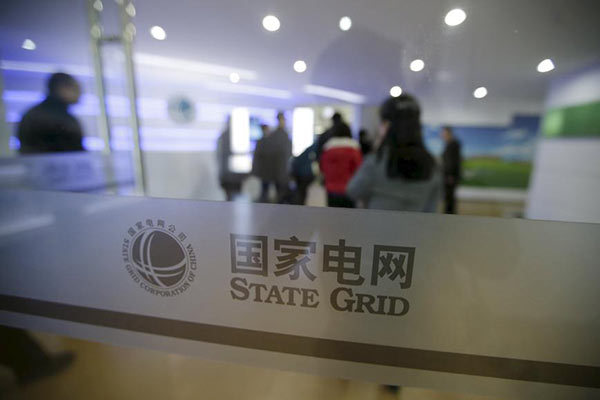
Staff members walk into a wind and solar energy storage and transmission power station of State Grid Corporation of China, in Zhangjiakou of Hebei province, March 18, 2016.[Photo/Agencies] |
Last week, the Australian government blocked State Grid Corporation of China and Cheung Kong Infrastructure Group's bid to lease Ausgrid, a major New South Wales state power grid, on national security grounds. The two Chinese companies had bid $7.7 billion to lease the grid for 99 years.
Although the Chinese companies can appeal against the move in a week, they are not likely to succeed in leasing Ausgrid because the Australian federal government can use "national security" again to veto their bid, as it had done to the SGCC bid for Transgrid in the same state in November.
Australia's Federal Treasurer Scott Morrison declined to detail the security issues involved, saying: "The issues are real. They're matters obviously of national security interest to the Commonwealth and elaborating on those obviously would not be in the national interest either."
Some security analysts have even alleged that a Chinese-controlled Ausgrid could be shut down because of cyberattacks, and their views have been widely reported by the Western media.
As the world's largest electricity utility company, SGCC has been successfully managing the power grid in China as well as many other projects around the world, including those in the Australian Capital Territory, Queensland, South Australia and Victoria. And it was the most competitive bidder for Ausgrid because of its efficient management and service capacity.
But these facts are not enough for the analysts to abandon their China-phobia. Instead, the analysts abandoned rational thinking to connect a Chinese world-class company's project in Australia with a hacker attack in Ukraine-purportedly by Russia-linked hackers-which US officials called a nightmare scenario because of their selfish interests.
How will Morrison and those analysts explain the ousting of SGCC from the Transgrid bid in November and granting it to an investor group whose 40 percent stakes are controlled by investors from the Middle East, a region which the West often associates with terrorism?
According to KPMG, China has invested about A$70 billion ($54 billion) in Australia since 2009, and replaced the US as the largest investor in Australia in 2013. Chinese investments have gone into Australia's strategically important sectors such as mining, agriculture and infrastructure, and helped boost the country's economy and improve its people's livelihoods. The $7.7 billion bid for Ausgrid could have been spent on Sydney's rail and road infrastructure. New South Wales Treasurer Gladys Berejiklian said she respected the federal government's decision, but emphasized: "There will be no delays to our infrastructure pipeline."
The turning point in Australia's attitude toward Chinese investments came in October when China's Landbridge Group leased the Port of Darwin for $506 million for 99 years. The deal was criticized by some Australian strategy experts and US officials but supported by the local governor. Northern Territory Chief Minister Adam Giles said the criticisms are aimed at instilling fear among Australians against China, especially because the Chinese company "has submitted a full application to the Foreign Investment Review Board of Australia regarding its desire ... and also consulted heavily with the Department of Defense."
Even if the Sino-Australia Free Trade Agreement, the result of nearly 10 years of hard negotiations, comes into effect two months later, Chinese investments in Australia will remain a contentious issue because Canberra chose to side with Washington against Beijing in the South China Sea dispute.
After the Tansgrid farce, Australia rejected Chinese consortiums' bid to purchase two pastures early this year. Australia's decisions, to a large extent, have been influenced by the US' reaction. In the process, fair play has been fallen prey to a partisan game.
But if Australia continues to see its largest investor and trade partner as a threat to its national security, China has enough reasons to take countermeasures.
The author is a writer with China Daily. liyang@chinadaily.com.cn

Copyright 1995 - . All rights reserved. The content (including but not limited to text, photo, multimedia information, etc) published in this site belongs to China Daily Information Co (CDIC). Without written authorization from CDIC, such content shall not be republished or used in any form. Note: Browsers with 1024*768 or higher resolution are suggested for this site.
License for publishing multimedia online 0108263 Registration Number: 130349