 |
|
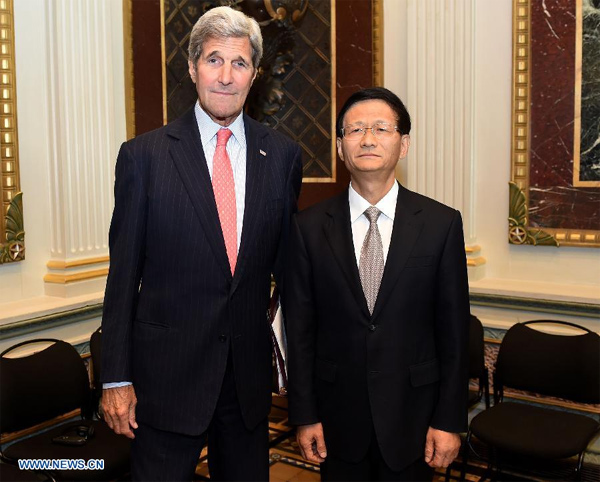
President Xi Jinping's special envoy Meng Jianzhu, a member of the Political Bureau of the Central Committee of the Communist Party of China (CPC) and head of the Commission for Political and Legal Affairs of the CPC Central Committee meets with U.S. Secretary of State John Kerry, in Washington D.C., capital of the United States, Sept. 11, 2015. China and the United States have reached important consensus on combating cyber crimes. [Photo/Xinhua] |
High hopes have been placed on President Xi Jinping's state visit to the United States, because many believe it could boost bilateral cooperation in cybersecurity in times of a looming "war" over cyber theft. In fact, cybersecurity is expected to top the agenda of the meetings between President Xi and his US counterpart Barack Obama.
These are challenging times for China and the US both, as the Obama administration is reportedly working on a package of economic sanctions against Chinese companies and individuals that Washington claims have benefited from the alleged cyber-theft of valuable US trade secrets. Actually, China-US disputes intensified even before former National Security Agency contractor Edward Snowden exposed the US' aggressive surveillance program at home and abroad more than two years ago causing huge embarrassment for Washington. Other countries' leaders, including German Chancellor Angela Merkel, corporations and organizations all have become US surveillance targets, according to Snowden.
At the beginning of 2013, US private security company Mandiant released a report, titled "APT1: Exposing One of China's Cyber Espionage Units", which accused the Chinese military of stealing US intellectual property. The US administration went a step further by indicting five Chinese military officers last year for alleged cyber theft, and over the past two months it has threatened to launch cyberattacks on China.
Matters didn't end there, as Washington went on the offensive and stalled China-US cooperation in cybersecurity. Assuming that the traditional semi-open dialogues can no longer put adequate pressure on China, the US has resorted to the "name and shame" game since 2013. Washington's irresponsible indictment of five Chinese military officers last May and threat to impose sanctions against some Chinese companies and individuals have left Beijing no choice but to stand up for its rights.
Judging by the cases mentioned above, Washington's "standard operating procedure" usually starts with some offensive actions, leading to a rapid deterioration in bilateral coordination on cyberspace that China is "obliged" to deal with. More importantly, the US' actions are to meet the political "demands" at home.
Related Stories
Copyright 1995 - . All rights reserved. The content (including but not limited to text, photo, multimedia information, etc) published in this site belongs to China Daily Information Co (CDIC). Without written authorization from CDIC, such content shall not be republished or used in any form. Note: Browsers with 1024*768 or higher resolution are suggested for this site.
License for publishing multimedia online 0108263 Registration Number: 130349