 |
|
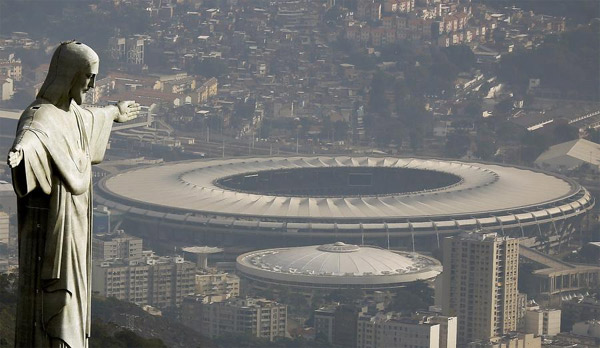
An aerial view shows the Christ the Redeemer statue with the Maracana stadium, where the opening cermony of the Rio 2016 Olympic Games will be held, in Rio de Janeiro, Brazil, July 16, 2016. [Photo/Agencies] |
The Olympic Games celebrates struggle for excellence, not costs. As more emerging economies are hosting the Olympics, it is time to recall the Olympic Creed.
When Brazil won the right to host the Summer Olympics six years ago, its economy was booming after years of former president Luiz Inacio Lula da Silva's successful economic policies. Today, the Brazilian economy is struggling amid its worst recession since the 1930s,
But the economic fall of Brazil as host country is only part of the big picture. The other part has to do with cost overruns. The initial cost of organizing the Rio Olympics was estimated at $2.8 billion. The current budget is closer to $5 billion. But the total Olympic budget, initially estimated at $12 billion, is closer to $20 billion — more than 22 times what Brazil is spending to contain the Zika virus.
Worse, cost overruns have been the rule of Summer and Winter Olympics since the 1960s.
When the first modern Olympic Games was held in Athens in 1896, the final bill was $10 million in today's money. With expenditures climbing since the 1970s, cost overruns have often meant substantial social losses. The Montreal 1976 Olympics is a case in point. The Canadian city spent the next three decades paying off the multi-billion dollar bill.
The Barcelona 1992 Olympics ($9.7 billion cost, 266 percent cost overrun) and Athens 2004 ($3 billion, 49 percent cost overrun) contributed to soaring debts in Spain and Greece.
In the case of the Summer Olympics, only few hosts — Beijing in 2008 — have managed to keep the cost overrun low. The cost of the London 2012 Games was $15 billion, with the cost overrun being 76 percent.
The Winter Olympics started in France in 1924. For nine decades it was mainly the advanced economies that hosted the Winter Games, with some hosting it twice or more (including Switzerland, the United States and Japan).
Mexico became the first emerging economy to host the Summer Games in 1968, followed by Moscow in 1980 and Beijing in 2008. The past decade saw the Olympic torch shifting from advanced to emerging economies. The trend will continue as South Korea and China will host the 2018 and 2022 Winter Games.
There are three probable future scenarios for the Games. In the "dead-end scenario", the Olympics will continue as before. In that case, soaring costs and cost overruns will virtually ensure the Games will be held mainly and repeatedly in prosperous economies, or in a few large emerging ones. In weaker economies, the Games are vulnerable to further economic erosion and social division.
In the "cost-control scenario", successful planning, rigorous cost-control and ability to re-purpose the Olympic facilities will play the key role. But the Games will stay mainly in those few advanced or emerging economies that are willing and able to foot the bill.
In the "multipolar scenario", excessive expenditure will be contained not just through planning and cost-control but cooperation. Today, the Olympics is held in several cities of one country. In this scenario, the Games could be held across multiple cities in one region, say, in Africa, the Americas, South and Southeast Asia, and the Middle East. In this way, smaller and emerging economies, along with larger ones, could host a multipolar and more inclusive Olympics.
According to the Olympic Creed: "The most important thing in the?Olympic?Games is not to win but to take part, just as the most important thing in life is not the triumph but the struggle. The essential thing is to have fought well."It is not the size of the stadium that matters but our ability to dream and the quest for excellence.
The author is a guest fellow at Shanghai Institutes for International Studies. This article is based on his SIIS project on "China and the multipolar world economy".

Copyright 1995 - . All rights reserved. The content (including but not limited to text, photo, multimedia information, etc) published in this site belongs to China Daily Information Co (CDIC). Without written authorization from CDIC, such content shall not be republished or used in any form. Note: Browsers with 1024*768 or higher resolution are suggested for this site.
License for publishing multimedia online 0108263 Registration Number: 130349