 |
|
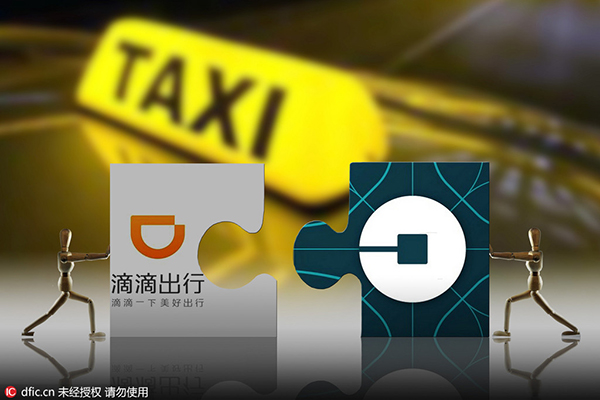
Beijing-based Didi, the dominant ride-hailing service provider in China, said in a statement on Monday that it will buy Uber's China operation. [Photo/IC] |
The merger between two rival cab-hailing companies, Didi Chuxing and Uber China, has ended their costly battle in the ride-hailing market. Didi will take control of Uber China's brand, businesses, data and other assets in the country, yet both will continue to run independently.
But the Didi-Uber marriage is likely to create an unparalleled ride-hailing juggernaut that controls more than 90 percent of the market, fueling concerns about a de facto monopoly. Besides, the merger was announced without making a business declaration to the Ministry of Commerce, a legal requirement for all businesses with large-scale operations whose merger could result in a monopoly.
In the light of the country's anti-monopoly law designed to "protect fair market-oriented competition", the merged entity could take advantage of its dominant position to the detriment of users and competitors both.
The two former rivals are independent legal entities that run ride-hailing businesses on the Chinese mainland and, hence, their combination belongs to "merger of business operators". But even such a merger is not exempt from business declaration.
According to the anti-monopoly law, such exemption works only when one party in the merger owns at least 50 percent of other parties' voting shares or assets, or more than half of each party's voting shares or assets are owned by the same operator not in the merger. Apparently, no individual investor holds that many shares in either Didi or Uber China.
More important, the Didi-Uber juggernaut, born just a few days after China legalized the cab-hailing service, will almost certainly lead to exclusion or restriction of competition in the market.
Having poured money into subsidies for drivers and passengers over the past two years, the two companies are followed by a great number of users both on the supply and demand sides. Their service can also be accessed via third-party mobile platforms such as WeChat and Baidu Map.
Given its dominant role in the demand side, the newly merged entity is expected to further marginalize other competitors' market shares, and even infringe upon customers' legal interests.
The fear of monopoly aside, for any merger or acquisition in China, the total turnover of the companies involved should be more than 2 billion yuan ($302 million) in last fiscal year. But since neither Didi nor Uber China is a listed company, it is difficult to estimate the size of the merged entity's business. So the merger is not immune from investigation by Chinese anti-trust authorities, and they have the right to annul it if the new entity poses a monopoly threat or is not exempt from business declaration.
In fact, not just Didi, many Chinese internet enterprises, including search giant Baidu Inc and e-commerce giant Alibaba Group Holding Ltd, have adopted a variable-interest entities structure to bypass restrictions on the services they provide. Their business is under the actual control of overseas shareholders in tax havens like Cayman Islands. And they sign special deals with domestic technology companies to enter the mainland market.
Such a mode, if not properly handled, could cause serious security risks such as the leaking of users' information or exposure of sensitive locations. And although China's draft foreign investment law has proposed to put it under supervision, it is yet to take effect.
Therefore, more legislative efforts are needed to protect the privacy of Chinese users who use internet-based apps, as well as assess the security risks that come along with those apps.
The author is a researcher at the China University of Political Science and Law. The article is an excerpt from his interview with China Daily's Cui Shoufeng.

Copyright 1995 - . All rights reserved. The content (including but not limited to text, photo, multimedia information, etc) published in this site belongs to China Daily Information Co (CDIC). Without written authorization from CDIC, such content shall not be republished or used in any form. Note: Browsers with 1024*768 or higher resolution are suggested for this site.
License for publishing multimedia online 0108263 Registration Number: 130349