 |
|
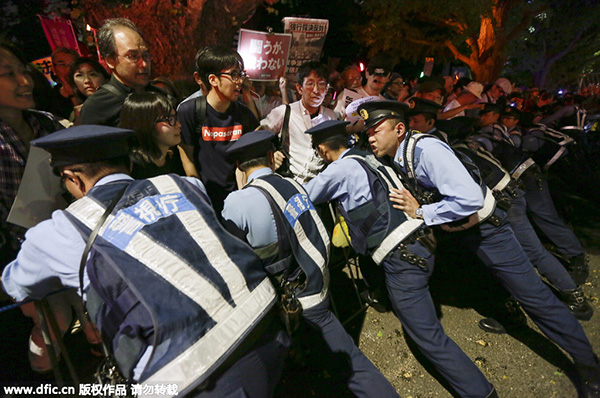
Japanese policemen contain protesters as they demonstrate against Japan's controversial national security bills in front of Japan's parliament building in Tokyo, Japan, Sept 14, 2015. [Photo/IC] |
On Monday, a radar station on Japan's Yonaguni Island manned by about 160 Self-Defense Forces personnel came into service, about 150 kilometers from the Diaoyu Islands.
On Tuesday, Japan's controversial new national security laws, which allow the SDF to engage in combat overseas and exercise "collective self-defense", took effect. They are said to be indispensable for a more "proactive" Japan aspiring for greater contributions to global "peace and security".
In theory, and in the official rhetoric, neither move is targeted specifically at China.
But it would be dangerous to look aside from the game-changing potential of such moves, as well as the direct threat they represent to China.
Militarization of the southwestern-most island of Japan is only the beginning of a wider military build-up along the Japanese island chain. Even without the "in-private" murmurs heard in Tokyo, everybody knows this is being done with China in mind.
And there seems no way to change it.
Over 90 percent of constitutional experts in Japan believe the new laws are unconstitutional. Numerous polls in Japan have shown the majority of Japanese people oppose them. The public has protested. So have neighboring countries. Yet the laws survived parliamentary scrutiny.
With Shinzo Abe's ruling coalition holding a commanding majority in both houses of the Diet, the demise of the war-renouncing Article 9 of the Japanese Constitution seems to be just a matter of time and procedure.
Worrisome changes will ensue; including in the South China Sea, where Tokyo has been tirelessly fanning the flames between disputing parties. Sending SDF vessels to patrol there will mean readiness to confront China on a broader front.
Beijing has expressed the hope that Tokyo will "do more that facilitates regional peace and stability, instead of the opposite". Tokyo is doing exactly the opposite.
With Abe trying desperately to put the South China Sea issue on the table of the upcoming G7 summit, Beijing should not let the vain hope for "friendship" get in its way of coping with a now-very-different Japan. A Japan determined to be the US' foremost pawn in the containment of China. A Japan that seems prepared for long-term confrontation with China.
Talks with Tokyo are fine, as long as they are conducive to preventing or managing a crisis. But our policies should always be grounded in what is happening, not what we wish would happen.
The truth is China-Japan relations have just reached a watershed, and they are entering an era brimming with uncertainties.

I’ve lived in China for quite a considerable time including my graduate school years, travelled and worked in a few cities and still choose my destination taking into consideration the density of smog or PM2.5 particulate matter in the region.

Copyright 1995 - . All rights reserved. The content (including but not limited to text, photo, multimedia information, etc) published in this site belongs to China Daily Information Co (CDIC). Without written authorization from CDIC, such content shall not be republished or used in any form. Note: Browsers with 1024*768 or higher resolution are suggested for this site.
License for publishing multimedia online 0108263 Registration Number: 130349