 |
|
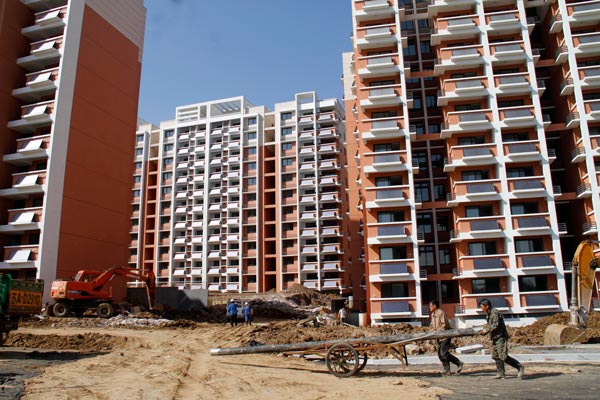
A property construction site in Nanjing, capital of Jiangsu province. [Photo/China Daily] |
Macroeconomic statistics released over the weekend have sent a mixed message, that while growth remains weak, there are signs of stabilization. But as the recent boom in the real estate sector shows, policies targeted at stabilizing the economy could be misused, leading to risk accumulation and making it harder for policymakers to handle the situation in the future.
Both industrial production and retail sales increased at a slower rate in the first two months compared with December 2015, which means policymakers still face huge pressure to reduce overcapacity and stabilize growth.
The market is expecting the government to issue more policies to anchor the economy, and tax cuts, loosening of the monetary policy and fiscal stimulus are thought to be in the pipeline. From the latest development of the real estate sector, however, it is advisable that policymakers be more careful in devising economy-stabilizing policies.
Thanks to the policy to cut mortgage down payment, released in early February, and ample liquidity in the market, home sales soared in some big cities such as Beijing and Shenzhen. Real estate investment growth, meanwhile, has picked up increasing China’s fixed-asset investment.
Such strong growth in investment may offer some relief to policymakers, but some undesirable abnormalities have emerged in the real estate sector, including the down payment loan scheme by real estate developers, agencies and online fundraising platforms to boost home sales.
Some people who cannot afford an apartment have even join hands to pay the down payment for mortgage with a view to selling the property later to profit from the rising prices. Such a speculative crowd-funding scheme could have serious consequences on the sector and points to the lack of proper regulation, which could ultimately lead to materialization of risks affecting economic and financial stability.
The US subprime mortgage crisis, the source of the global financial crisis in late 2000s, arose because those who could not afford a home were offered nearly zero-down payment arrangements through various financial schemes, which in turn pushed up prices. And when the rise in prices became unsustainable, there came the bust.
China seems far removed from such a scenario, because the amount of funds involved in either the down payment loan or the crowd-funding scheme in the country remains small. But if housing prices continue to rise fast, more such regulation-circumventing schemes could emerge to pose a potential threat to China’s financial stability.
Zhou Xiaochuan, governor of China’s central bank, said on Saturday that the authorities will launch a crackdown on illegal fund-raising activities, including the provision of loans for down payment in the real estate sector. Unequivocal as it is, the central bank’s stance also shows policymakers might have failed to anticipate such contingencies and have not planned targeted countermeasures.
As the macroeconomic situation gets ever more complicated, policymakers must think about the possible outcomes of their decisions. For example, while the move to reduce overcapacity is set to improve the operational efficiency of sectors such as steel and coal mining, and benefit China’s overall economic restructuring agenda, policymakers may also face some difficulties because its effects could spill over to affect the interest of large groups of people.
Massive lay-offs were an offshoot of the market-oriented enterprise reforms in the 1990s, which seriously affected the lives of many of people. But policymakers have vowed that history will not be repeated this time.
Such promises may reassure those who could be affected by the campaign to reduce overcapacity. But policymakers must also be prepared to correct possible distortions in the implementation of the policies and work out countermeasures to protect the interests of people who could be affected.
The author is a senior writer with China Daily. xinzhiming@chinadaily.com.cn



Copyright 1995 - . All rights reserved. The content (including but not limited to text, photo, multimedia information, etc) published in this site belongs to China Daily Information Co (CDIC). Without written authorization from CDIC, such content shall not be republished or used in any form. Note: Browsers with 1024*768 or higher resolution are suggested for this site.
License for publishing multimedia online 0108263 Registration Number: 130349