 |
|
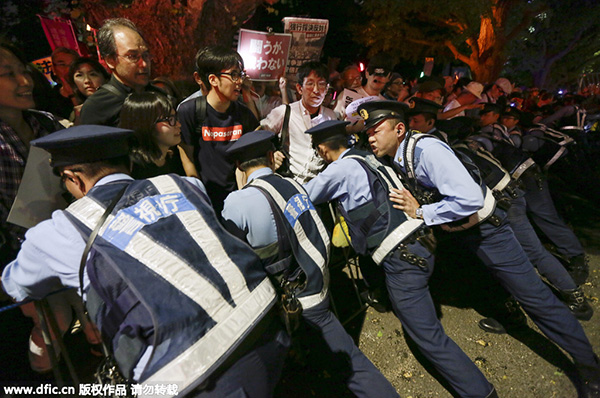
Japanese policemen contain protesters as they demonstrate against Japan's controversial national security bills in front of Japan's parliament building in Tokyo, Japan, Sept 14, 2015. [Photo/IC] |
TOKYO -- Japan's new controversial security laws came into effect on Tuesday, 6 months after being enacted following the forced passage of related bills through both chambers of parliament amid a monument public backlash.
The new laws, marking Japan's biggest legislative post-war security shift and reversing seven decades of pacifism, will permit Japanese forces to engage in combat overseas in a move that has drawn the ire of Japan's neighbors and the international community for threatening to destabilize security and peace in the Asia-Pacific region.
For Japan's Prime Minister Shinzo Abe, it has been his political holy grail to allow Japanese troops to fight overseas for the first time since the Imperial Army of Japan brutalized regions in east and southeast Asia prior and during WWII.
The hawkish leader cited a need to boost the operational and geographical scope of Japan's forces due to a perceived changing security dynamic in the immediate region as well as to better support its allies, such as the United States.
The legislation will now allow Japan, against its once-revered pacifist constitution, to exercise the right to collective self-defense and permit Japanese forces to come to the aid of its allies and friendly nations under armed attack even if Japan itself is not being threatened.
Article 9 of Japan's Constitution, however, bans Japan from using force to settle international disputes and previous administrations have maintained that under international law Japan has the right to collective self-defense but is prohibited by Japan's Supreme Law from exercising it.
In July last year, however, Abe's Cabinet unilaterally decided without a broader political or public mandate on the issue, to reinterpret the key clause and decided that if an ally was under attack and this posed a threat to Japan's survival and no other means other than force could prevent the attack, that a minimum amount of force would be allowed by Japanese forces to repel an attack.
Despite constitutional experts, scholars and lawyers all finding the reinterpretation to be grossly flawed and the subsequent war-linked legislation unlawful, Abe's majority in both chambers of parliament ensured the bills' passage and enactment into law, against a backdrop of nationwide public protests and international condemnation.
Copyright 1995 - . All rights reserved. The content (including but not limited to text, photo, multimedia information, etc) published in this site belongs to China Daily Information Co (CDIC). Without written authorization from CDIC, such content shall not be republished or used in any form. Note: Browsers with 1024*768 or higher resolution are suggested for this site.
License for publishing multimedia online 0108263 Registration Number: 130349