|
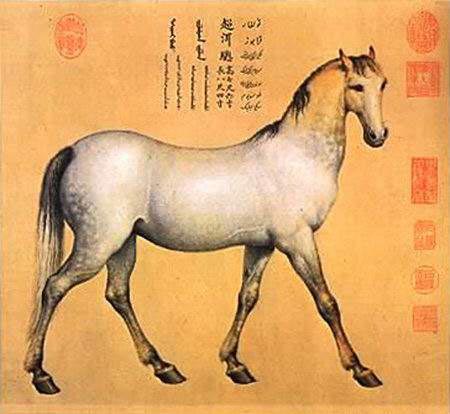
This painting, one of Giuseppe Castiglione's Afghan Four Steeds, features a horse named Chaoni'er. Castiglione was an Italian missionary. |
Linguistic record
 |
|
|
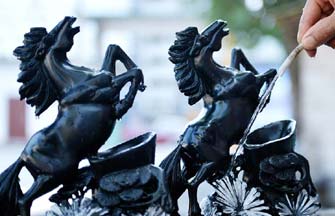 |
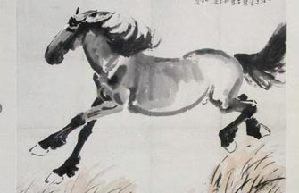
Apart from serving as a symbol of loyalty and bravery for military heroes, the horse is often praised for its endurance, as illustrated in the proverbial thousand-mile horse.
Perhaps the best analogy for man's relationship with the horse concerns Bole, a wise man with an eye for the next thousand-mile horse. Here, the human being is the talent scout, manipulator and trainer, while the horse is to be observed for potential, and groomed. A mentor-protege parallel is quite obvious.
As such, the horse may also become the recipient of tiger-mom-style Chinese tough love, as in the phrase "A horse has to be whipped to run."
But ancient Chinese tended to identify with the animal so closely that when they talked about their horses they could be talking about themselves. "To err is human" has a Chinese equivalent: "Man may make mistakes and a horse may miss a step".
Chinese in general have a weakness for patting a horse on the butt, a friendly gesture that has since evolved to mean sycophancy. When you miss a beat and end up patting it on the leg, you have failed in the unctuous act of flattering someone.
In these sayings, the horse is no longer man's servant or apprentice, but an object of appreciation and power. This kind of duality is also present in the traditional Chinese perspective on entertainers.
While the man-horse power dependence may change with different situations, the horse reigns supreme in the equine hierarchy.
The donkey and the mule usually appear as sidekicks or foils in Chinese folktales to make the horse appear as magnificent as the superhero in a Hollywood fantasy film. About the only time the horse is overshadowed is by the appearance of the camel, which is so much bigger that, according to Chinese lore, even the thinnest one is still larger than the horse. But then, the camel has never been credited as a conqueror of the world.
There is no doubt that Chinese, ancient or modern, love the horse. But those who take "ma" (horse) as their surname cannot prove they are any different from the rest of us.
As it happens, Chinese Muslims took the sound for Muhammad and sinicized it to ma, hence the largest family name in this ethnic group. Also, Chinese rarely use the word in any last name for its literal meaning, otherwise wang (or wong in Cantonese, meaning king) would be the most coveted of all.
But even a king or emperor could enhance his regal stature while posing on a horse.
For more X-Ray, click here


Copyright 1995 - . All rights reserved. The content (including but not limited to text, photo, multimedia information, etc) published in this site belongs to China Daily Information Co (CDIC). Without written authorization from CDIC, such content shall not be republished or used in any form. Note: Browsers with 1024*768 or higher resolution are suggested for this site.
License for publishing multimedia online 0108263 Registration Number: 130349