Celebrated stallions
 |
|
|
 |
These warhorses belonged to Emperor Taizong (AD 598-649), also known as Li Shimin, of the Tang Dynasty (AD 618-907). He commissioned artisan Yan Lide and painter Yan Liben, who were brothers, to carve six warhorses he rode before he built his empire. The reliefs, each standing 1.7 meters high and 2 meters wide, used to flank the sacrificial altar to the north of the mausoleum.
The steeds have poetic names that mostly denote their markings. Four of them were hit by arrows and the emperor left memorial tributes to each of them along with records of the military campaigns in which they carried him or in which they fell.
The carvings were broken apart early in the 20th century and two of them were smuggled out of China. They are now housed in a museum at the University of Pennsylvania, while those remaining in China are in a museum in Xi'an, the Shaanxi provincial capital.
By aesthetic standards of the day, they were quite realistic. Horses made frequent appearances in ancient scroll paintings, but most were static and inconspicuous, acting as loyal companions to reclusive scholars or officials seeking sanctuary in nature.
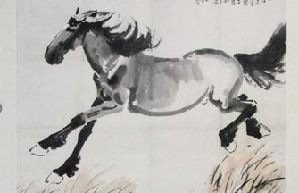
Unlike ancient artists obsessed with saddled horses, Xu Beihong (1895-1953) preferred feral and wild ones. Trained in France, the Chinese master studied equine anatomy, spending hours observing horses' movements and expressions. Especially fond of Mongolian breeds, he left a treasure trove of up to 1,000 sketches.
Xu's portrayals of horses galloping or trotting past, in a rich variety of poses, are some of the most captivating of their kind. Using mostly black ink, they combine the best methods from East and West. The lines and brush strokes are simple, yet invariably evoke the essence of the animals.
They are a contrast to the horses painted by Giuseppe Castiglione (1688-1766), an Italian missionary who created many eight-horse images for the Qing emperors. In full color and resembling traditional European oil paintings, they were, however, closer in spirit to the Chinese style of depicting horses. There was nothing of the energy and exhilaration found in Xu's drawings.
For more X-Ray, click here


Copyright 1995 - . All rights reserved. The content (including but not limited to text, photo, multimedia information, etc) published in this site belongs to China Daily Information Co (CDIC). Without written authorization from CDIC, such content shall not be republished or used in any form. Note: Browsers with 1024*768 or higher resolution are suggested for this site.
License for publishing multimedia online 0108263 Registration Number: 130349