|
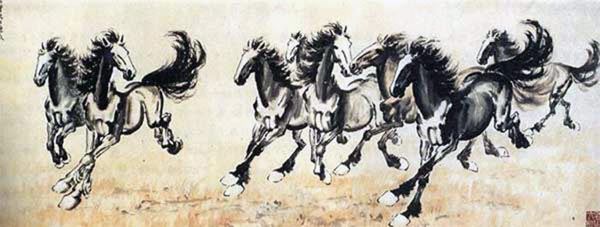
A signature ink painting by Xu Beihong, who trained in France and spent hours studying horses' movements and expressions.
|
Different emphasis
 |
|
|
 |
It is true that China may pale in comparison with the West in creating talking horses or weeping horses in art and literature, with most of our horse-related prominence being in our vocabulary.
But before we get to that, I'll point to the different emphasis, or rather East-West focus, on different aspects of the horse. For example, most English words for "horse" define the animal by age and gender, such as colt for a male horse under the age of 4, filly for a female horse less than 4 years old, mare for a female aged 4 or older, yearling for one between 1 and 2 years old, and foal for one younger than a year old. Gelding and stallion denote castration or non-castration.
In contrast, most Chinese descriptions for the horse concern colors. Biao (驃) is yellow; liu (騮) is red with black mane and tail; yan (骃) is grayish; li (驪) is black; guo (騧) is yellow with black mouth; qi (騏) is purplish black; hua (驊) is red like the fruit date; xing (骍) is another kind of red; cong (驄) is blue; zhui (騅) is black with white feet; and mang (駹) is black with white face. Ju (駒) and ji (驥) refer to young and old horses, but not how young or how old, while jun (駿) and nu (駑) are names for fast and slow ones.
We have more names for different horses than there are zodiac animals, but most of them appear to have been inspired by the color spectrum.
We Chinese also have an equivalent for the term "prince charming" that has a whiff of the fairytale about it. It is "prince on a white horse" or "white-horse prince".
But a study of the colors of horses' coats made me realize the inherent irony in this Disney-like phrase: With rare exceptions, a horse turns gray or white as it ages, and is usually born with a darker shade. If you are not sure, check the skin underneath a white horse's coat.
So, associating a prince with mortality is not really the best way to present his youthful charm. However, since most of us are not equine veterinarians, we can be excused for envisioning this most desirable companion for females in the color of purity and forget about old age.
For more X-Ray, click here


Copyright 1995 - . All rights reserved. The content (including but not limited to text, photo, multimedia information, etc) published in this site belongs to China Daily Information Co (CDIC). Without written authorization from CDIC, such content shall not be republished or used in any form. Note: Browsers with 1024*768 or higher resolution are suggested for this site.
License for publishing multimedia online 0108263 Registration Number: 130349