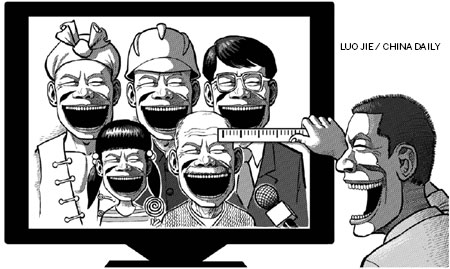
When a migrant worker was asked, "ni xing fu ma?" (are you happy?), by a China Central Television interviewer, he looked puzzled before replying, "wo xing Zeng (my surname is Zeng). This CCTV interview telecast during the Golden Week National Day holiday has become a joke among CCTV viewers.
In fact, xingfu (happiness) has become a buzzword since CCTV broadcast its survey on Chinese people's happiness. But the survey results have failed to convince many people, for they were surprised to see every interviewee saying he/she was happy.
The question then is, are all of them truly happy?
The rural migrant worker surnamed Zeng first turned down the interview, saying: "Don't ask me (any questions). I'm just a migrant worker." After being repeatedly asked, "ni xing fu ma?", he finally replied: "Wo xing Zeng".
His answer shows migrant workers and TV reporters live in different worlds and they cannot even communicate with each other.
Similarly, when asked, "Are you happy?", a 73-year-old man collecting used plastic bottles in a street in Haining, Zhejiang province, said: "The bottles can be sold for 0.1 yuan each." Asked again, he said: "I live on government subsidy of 650 yuan ($103) a month. The government is good." The reporter pestered on: "My question is, 'Are you happy?'" The senior citizen replied: "I am deaf."
Many netizens have scoffed at the reporters' art of asking questions and their insistence on reaching the same conclusion - that the interviewees including the migrant worker and the senior citizen are "happy" even though they didn't understand the interviewers' questions.
Governments at all levels deserve praise for their efforts to provide welfare for senior citizens amid the increasing pressure of an aging society. But when a man in his 70s has to survive by collecting used bottles and a small government subsidy, doesn't it mean much still needs to be done to improve social security, especially for senior citizens?
True, happiness cannot be evaluated in concrete terms. But in sharp contrast to the same answers that the TV interviewers' elicited, online surveys show more than half of the respondents saying they were unhappy. The online interviewees said openly that they cannot be happy given the difficulties they face. The reasons for the unhappiness ranges from issues such as poor healthcare, education, income and employment to the Diaoyu Islands.
The Communist Party of China and the government have always emphasized the importance of learning about people's true situation and reflecting their wishes and opinions.
At the CPC's 90th anniversary gathering on July 1, 2011, General Secretary Hu Jintao said: "We must consult the people on policies, learn about their needs, and seek suggestions from them. We must listen to their views, truthfully reflect their wishes, help alleviate their hardships, and protect their economic, political, cultural, and social rights and interests in accordance with the law. The people will care about and feel close to the Party only when the Party feels the same toward them. Party and government offices at all levels and their officials should be more community-focused in their work, regularly visit communities, and stay close to the people. In this way, we can learn more about the actual conditions of the people, address their concerns, and give them a warm feeling that we care about them."
In 2010, Premier Wen Jiabao said: (Our aim is) "To let everyone lead a happy life with dignity. To let everyone feel safe and secure. To let society be one with equity and justice. And to let everyone have confidence in the future."
Many TV programs give common people the chance to voice their opinions. But the Chinese media should act responsibly to help identify people's difficulties and reflect their wishes, rather than create an impression that "everyone is happy".
China has maintained a fast-paced economic growth for more than 30 years and the quality of people's life has improved steadily, but many challenges are yet to be overcome.
In this year's Government Work Report, Wen said: "There are still some deficiencies and shortcomings in the government's work. Targets for conserving energy, reducing emissions, and controlling prices are not being met. Problems concerning land expropriation, housing demolition, workplace safety, food and drug safety, and income distribution are still very serious and the people are still very concerned about them. Government administration and services need to be improved, and efforts to build a clean government need to be intensified."
It is good that the Chinese media have begun focusing on people's happiness, but they should have a "down to earth" attitude, and follow the guidelines set by Party and government leaders to reveal people's difficulties and help the authorities learn about people's needs and improve their livelihood.
The author is a writer with China Daily.
liyang@chinadaily.com.cn
(China Daily 10/09/2012 page9)

I’ve lived in China for quite a considerable time including my graduate school years, travelled and worked in a few cities and still choose my destination taking into consideration the density of smog or PM2.5 particulate matter in the region.

Copyright 1995 - . All rights reserved. The content (including but not limited to text, photo, multimedia information, etc) published in this site belongs to China Daily Information Co (CDIC). Without written authorization from CDIC, such content shall not be republished or used in any form. Note: Browsers with 1024*768 or higher resolution are suggested for this site.
License for publishing multimedia online 0108263 Registration Number: 130349