Nuclear Meltdown
Mistakes, misfortune, meltdown: Japan's quake
(Agencies)
Updated: 2011-03-18 11:36
 |
Large Medium Small |
|
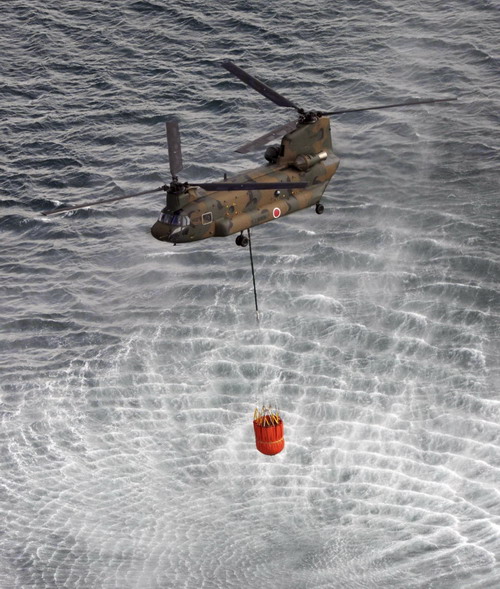 A Japan Air Self-Defense Force CH-47 Chinook helicopter collects water from the ocean to drop on the reactors at the Fukushima Daiichi nuclear plant in Fukushima March 17, 2011. [Photo/Agencies] |
A FAST CAR AND A GEIGER COUNTER
The government now planned to use helicopters to drop water onto the reactors in an attempt to cool them. Authorities had also brought in troops to help pump water at the stricken plant as part of their last-ditch efforts to prevent a meltdown.
Washington had offered help almost immediately after the quake. But its navy had also pulled back from the Japan coastline in an apparent effort to avoid any possible nuclear contamination.
US Nuclear Regulatory Chairman Gregory Jaczko questioned Japan's order to evacuate citizens within a 20-km radius from the plant. Under the Japanese order, people living within 30 km are advised to stay indoors. Jaczko said US citizens would be told to evacuate to an 80-km radius. By Wednesday afternoon, workers at Fukushima had resorted to taking radiation levels from a moving car as it drove past the main gate of the plant. The eight automated radiation monitoring points at Fukushima No. 1 relied on the same power that went down with the plant itself.
With gasoline reserves at the site dwindling, scientists initially decided to drive to the West Gate, stop, and then monitor radiation levels there.
Now the levels were so high that those sent in didn't stop. With only a single data point -- and a lot of noise -- it became harder to draw conclusions on what was happening at the plant.
"Readings can change with the weather and be affected by radiation in dust and other materials that accumulate," Tetsuo Ohumura of the Nuclear and Industrial Safety Agency told reporters. "We'll have to see how things change."
By Thursday morning, the cores of the No. 1, No. 2 and No. 3 reactors were believed to have partly melted. Just as worryingly, backup systems to provide water for a pool of spent fuel rods in No. 3 and No. 4 had also failed.
Japan's Air Self Defense Force had begun using Chinook helicopters to dump water on the damaged No. 3 and No. 4 reactors but with seemingly little impact.
Without water in the pools, radiation levels will spike to levels high enough to prove lethal with exposure of less than 20 seconds, according to a US projection based on a 1982 incident in a plant of the same design in Connecticut.
Absent some intervention, US experts predicted a wave of radiation that would drive workers back for their own safety.
|
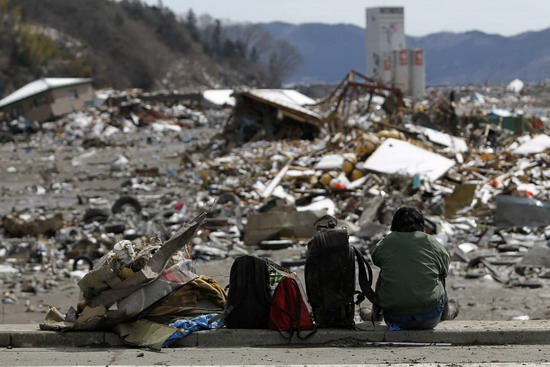 A survivor sits with belongings he found in the debris of his destroyed house in Yamada, Iwate Prefecture, days after the area was devastated by a magnitude 9.0 earthquake and tsunami, March 17, 2011. [Photo/Agencies] |
| 分享按鈕 |