Nuclear Meltdown
Mistakes, misfortune, meltdown: Japan's quake
(Agencies)
Updated: 2011-03-18 11:36
 |
Large Medium Small |
|
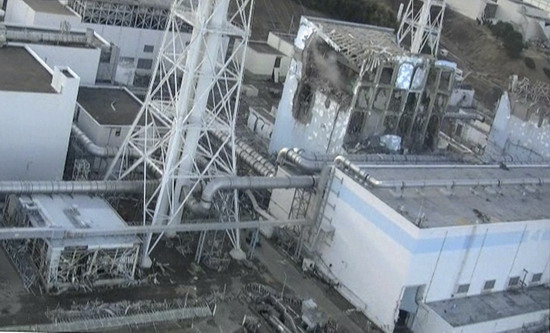 An aerial view taken from a helicopter from Japan's Self-Defence Force shows damage sustained to the No. 4 reactor (C) at the Fukushima Daiichi nuclear power complex in this handout taken March 16, 2011 and released March 17, 2011. [Photo/Agencies] |
TOKYO - By Thursday morning the last line of defense came down to this: a police water cannon, a helicopter maneuver designed for wildfires and a race against time to get the Fukushima Daiichi nuclear power plant rewired to the grid.
As a crew of about 100 Japanese workers and soldiers battled to keep a string of six nuclear reactors from meltdown just short of a week into Japan's nuclear crisis, the arsenal of weapons at their disposal remained improvised, low-tech and underpowered.
A police riot control truck was hauled in over uneven roads to keep a spray of water on the No. 3 and No. 4 reactors. In the air above, Japan Self-Defense Forces helicopters made runs with baskets of water in a desperate attempt to cool exposed fuel rods believed to have already partly melted down.
|
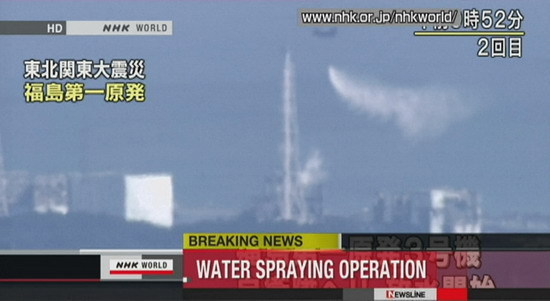 A military helicopter drops water on the reactors at the Fukushima Daiichi nuclear plant in this still image taken from video footage March 17, 2011. [Photo/Agencies] |
Meanwhile, technicians were dashing to complete what amounts to the world's largest extension cord: an electric cable to connect the stricken plant from the north and allow Tokyo Electric Power Company (TEPCO), which runs the plant, to restart critical water pumps taken out by the massive earthquake and tsunami that hit Japan on the afternoon of Friday, March 11.
An examination by Reuters of Japan's effort to contain its escalating nuclear disaster reveals a series of missteps, bad luck and desperate improvisation. What also emerges is a country that has begun to question some of its oldest values. Japanese have long revered the country's bureaucratic competence, especially when it is contrasted with its political dysfunction. Japan has also proudly often chosen to go its own way and turn down outside assistance. But what happens when competence begins to break down? And what happens when a disaster is so overwhelming that outside help is vital?
The Fukushima plant was designed to withstand a violent earthquake. But the massive tsunami that followed knocked out both the plant's electric-powered cooling system and its diesel-powered backup generators.
As the first pictures of the destruction around the northern town of Sendai were beamed across Japan and around the world in the hours after the quake, authorities initially said they had safely shut down the four nuclear plants closest to the earthquake and tsunami zone.
|
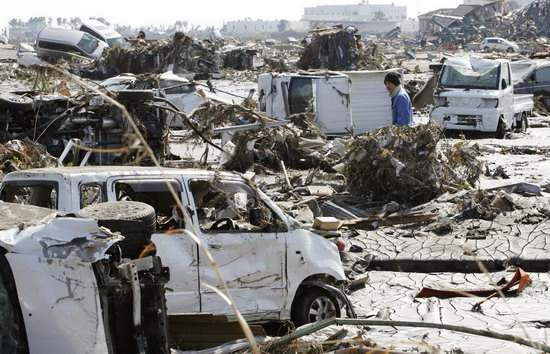 A resident looks around vehicles damaged by the earthquake and tsunami in Sendai, northeastern Japan March 13, 2011. [Photo/Agencies] |
It wasn't true. With no power to the plant's cooling system, the water that circulates around the fuel rods inside the six reactors at Fukushima had already begun to boil off. Within a few hours authorities declared a "nuclear emergency situation" at the plant. While no radiation release had been detected, they said, residents around the plant should evacuate.
It was the beginning of a new nightmare. Over the ensuing days, as Japan has struggled to come to terms with what could be more than 10,000 dead and raced to bring food and clean water to more than 500,000 people who lost their homes in the quake and tsunami, rapidly deteriorating conditions inside Fukushima have threatened a meltdown with the potential to spread radioactive particles across the country and beyond.
"They might have been prepared for an earthquake. They might have been prepared for a tsunami. They might have been prepared for a nuclear emergency, but it was unlikely that they were prepared for all three," said Ellen Vancko, an electric power expert with the Union of Concerned Scientists.
| 分享按鈕 |