Nuclear Meltdown
Mistakes, misfortune, meltdown: Japan's quake
(Agencies)
Updated: 2011-03-18 11:36
 |
Large Medium Small |
|
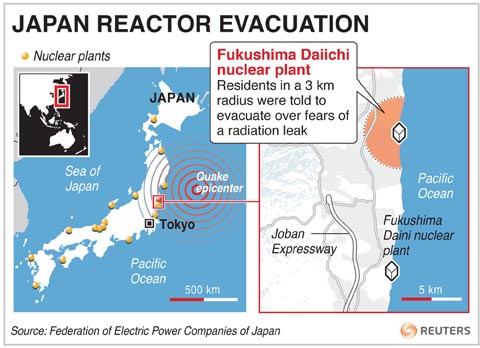 Map of Japan showing nuclear facilities and radius of evacuation around one plant where a state of emergency was declared following Friday's 8.9 magnitude earthquake. |
FIRST TROUBLE
Before last week, Japan's 55 nuclear reactors had provided about 30 percent of the nation's electric power. That percentage had been expected to rise to 50 percent by 2030 with a boom in new plant construction.
But nuclear power plants stop if they don't have enough power. Stranded nuclear reactors cannot circulate water to cool their fuel rods. When the existing water boils off, the nuclear fuel begins to heat, a process that can set fire to surrounding materials and touch off powerful hydrogen blasts.
"Power is the lifeblood for a power plant," said Harold Denton, who headed the US Nuclear Regulatory Commission team that handled the 1979 Three Mile Island crisis in the United States. "If you've got power, you can do a lot, but if you don't have any power, the water in the reactor vessels heats up and boils away and the fuel begins to melt. It's a problem they've gotten into now."
The threat for the Fukushima plant, 240 km (150 miles) northeast of Tokyo, is compounded, experts say, by the design of its 40-year-old reactors, known in the industry as the General Electric Mark 1.
Unlike newer models, the Tokyo Electric reactors in Fukushima each contain an upper chamber for storing spent fuel rods in a pool of water housed together in the same concrete shell as the active core of the reactor. A failure in one can lead to problems in the other.
On Saturday morning, Japanese officials reported increased pressure inside number 1 reactor. A few hours later, there was an explosion in one of the reactors.
|
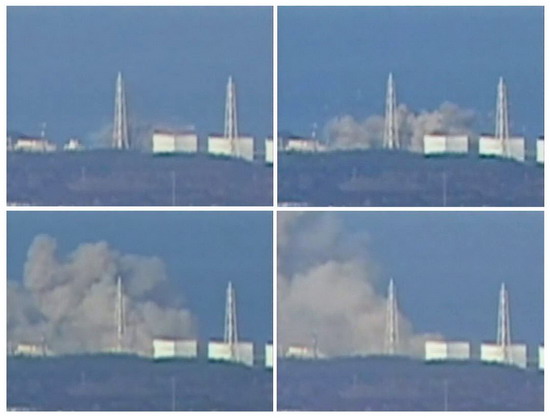 This combination photo shows smoke rising from Fukushima Daiichi 1 nuclear reactor after an explosion on Saturday March 12, 2011 in this still image sequence (from L-R, top to bottom) taken from video footage. [Photo/Agencies] |
TEPCO, the plant operator, said it had detected increased radioactivity levels around the plant but that the reactor's primary containment vessel had not been breached and no major leakage had occurred.
The company said it was about to begin pumping sea water into the reactors. They didn't explain it, but experts watching overseas immediately understood what it meant: the situation was so dire that the plants would never be saved. The priority now was to prevent a runaway meltdown.
As the level of radiation around the Fukushima complex topped safe levels, Japanese authorities began making preparations to hand out iodine -- used to protect the thyroid against radioactive exposure -- in the affected areas.
The following day, Sunday, Japan's nuclear safety agency said the Fukushima incident ranked as a 4 under the International Nuclear and Radiological Event Scale. By comparison, Three Mile Island was a 5 while Chernobyl was a 7 on the 1 to 7 scale.
Authorities were worried, but still optimistic that they could bring the plant back under control.
"SHUTTERS ROLLED"
The drama in Japan began just a day after the International Atomic Energy Agency's 35-nation Board of Governors had wrapped up its quarterly meeting in Vienna. Set up to "promote safe, secure and peaceful nuclear technologies" the IAEA has on staff some of the world's leading experts on nuclear safety.
But it quickly became apparent that the agency was struggling to keep up with what was unfolding on the other side of the world. The IAEA put out a series of short statements over the weekend, though at one point its website crashed and for several hours the press department had to refer journalists to statements posted on its Facebook page. It took three days for Director General Yukiya Amano, himself Japanese, to hold a news conference to address the emergency.
"Atomic contamination is threatening from Japan and what do you hear from the Vienna-based IAEA: dignified silence," a popular Austrian tabloid wrote. "The shutters are rolled down, just like for a weekend off."
When the markets in Tokyo opened on Monday, the response was inevitable: Japanese stocks fell more than six percent. On Tuesday, they would finish another 10 percent lower. The yen has spiked against the dollar this week as traders unwind their positions and Japanese investors pull out of foreign markets because they'll need the money at home.
|
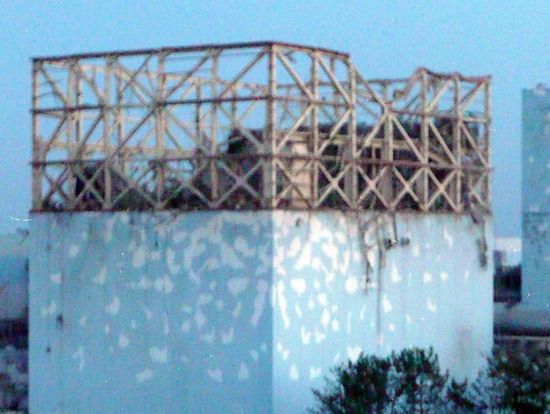 The damaged roof of reactor number No. 1 at the Fukushima Daiichi nuclear plant after an explosion that blew off the upper part of the structure is seen in this handout photo released by Tokyo Electric Power Company (TEPCO) in Fukushima Prefecture, northeastern Japan, March 12, 2011. [Photo/Agencies] |
| 分享按鈕 |