 |
|
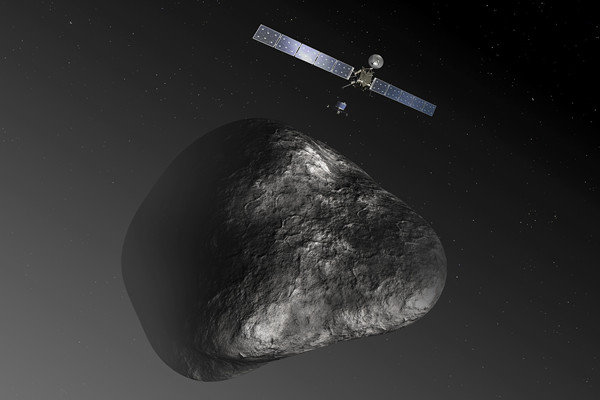
A handout image of an artist's impression, not to scale, of the Rosetta orbiter deploying the Philae lander to comet 67P/Churyumov-Gerasimenko, released by the European Space Agency (ESA) on December 3, 2013. [Photo/Agencies] |
DARMSTADT - Landing with a bounce after traveling 4 billion miles, a European spacecraft made history Wednesday by successfully reaching the icy, dusty surface of a speeding comet - a cosmic first designed to answer big questions about the universe.
The landing by the washing machine-sized craft after a decade-long journey required immense precision, as even the slightest error could have resulted in stellar calamity.
Indications were that the spacecraft touched down almost perfectly, save for an unplanned bounce, said Stephan Ulamec, head of the lander operation.
"Today we didn't just land once. We maybe even landed twice,"he said with a chuckle.
Ulamec said thrusters that were meant to push the lander, called Philae, onto the surface, and harpoons that would have anchored it to the comet failed to deploy properly. Initial data from the spacecraft indicated that it lifted off again, turned and then came to rest.
Scientists were still trying to fully understand what happened and whether those failures would affect the lander's ability to remain on the comet, called 67P/Churyumov-Gerasimenko. But so far, most of the instruments were working fine and sending back data as hoped, Ulamec said.
"Tomorrow morning we should know a lot more,"he said.
The landing team at mission control in Darmstadt had to sweat through a tense seven-hour wait that began when Philae dropped from the agency's Rosetta space probe as both it and the comet hurtled through space at 41,000 mph (66,000 kph).
During the lander's descent, scientists were powerless to do anything but watch, because its vast distance from Earth - more than 300 million miles - made it impossible to send instructions in real time.
Finally, at 16:03 GMT (11:03 a.m. EST), the agency received a signal that the lander had touched down.
While it may take a while to determine the exact state of the 220-pound (100-kilogram) lander, the fact that it was resting on the surface of the comet was already a huge success - the highlight of Rosetta's decade-long mission to study comets and learn more about the origins of these celestial bodies.
The head of the European Space Agency underlined Europe's pride in having achieved a unique first ahead of its U.S. counterpart, NASA.
"We are the first to have done that, and that will stay forever,"said the European agency's director-general, Jean-Jacques Dordain.
NASA contributed three instruments to the mission and its Deep Space Network of giant radio antennas has been key to communicating with Rosetta.
Eight-time spacewalking astronaut John Grunsfeld, now associate administrator for science at NASA, called the landing "a breakthrough moment in the exploration of our solar system and a milestone for international cooperation."
"The data collected by Rosetta will provide the scientific community, and the world, with a treasure-trove of data,"he said in a statement.
Scientists have likened the trillion or so comets in our solar system to time capsules that are virtually unchanged since the earliest moments of the universe.
"By studying one in enormous detail, we can hope to unlock the puzzle of all of the others,"said Mark McCaughrean, a senior scientific adviser to the mission.
The insight gleaned will give researchers the opportunity to test the theory that comets brought organic matter and water to Earth billions of years ago, giving them a key role in the evolution of life on our planet, said Klim Churyumov, one of the two astronomers who discovered the comet in 1969.
Rosetta and Philae will accompany the 2 {-mile wide comet as it races past the sun and becomes increasingly active in the rising temperatures. Between them, they will use 21 different instruments to take 3D images, analyze the comet's chemical composition and electrical properties, and even probe its internal structure with low-frequency radio signals.
Mission manager Paolo Ferri said there was no time to celebrate, because the lander had only enough battery power to operate for up to 64 hours. After that it will have to recharge, using solar panels to eke out an extra hour of operations each day.
Ferri said communications with the lander also needed to be stabilized, as there were intermittent connection problems after the touchdown. In the meantime, all the data that Philae collects is safely being stored for later transmission, he said.
Rosetta, which was launched in 2004, had to slingshot three times around Earth and once around Mars before it could work up enough speed to chase down the comet, which it reached in August. Rosetta and the comet have been traveling in tandem ever since.

Copyright 1995 - . All rights reserved. The content (including but not limited to text, photo, multimedia information, etc) published in this site belongs to China Daily Information Co (CDIC). Without written authorization from CDIC, such content shall not be republished or used in any form. Note: Browsers with 1024*768 or higher resolution are suggested for this site.
License for publishing multimedia online 0108263 Registration Number: 130349