 |
| [Infographic/Agencies] |
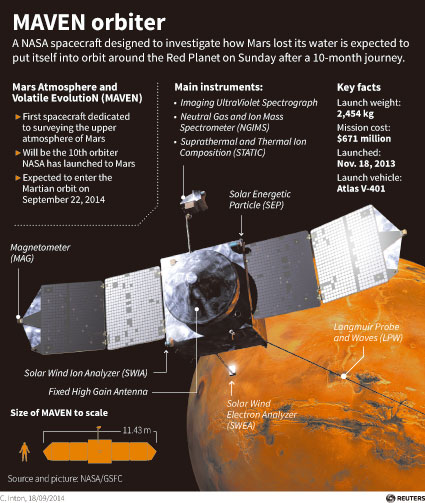
CAPE CANAVERAL, Fla - A NASA robotic spacecraft fired its braking rockets on Sunday, ending a 10-month journey to put itself into orbit around Mars and begin a hunt for the planet's lost water.
After traveling 442 million miles (71 million km), the Mars Atmosphere and Volatile Evolution, or MAVEN, spacecraft fired its six rocket thrusters, trimming its speed from 12,800 mph (20,600 kph) to 10,000 mph (16,093 kph).
The 33-minute engine firing left MAVEN in the clutches of Mars' gravity as it flew over the planet's north pole and slipped into a looping 236-mile by 27,713-mile (380-km by 44,600-km) high orbit.
"I don't have any fingernails anymore, but we made it," Colleen Hartman, NASA deputy director for science at Goddard Space Spaceflight Center in Greenbelt, Md., said during a NASA Television broadcast of MAVEN's arrival.
Flight control teams burst into cheers and applause as radio signals from MAVEN confirmed it was in Mars orbit at 10:25 p.m. EDT/0225 GMT.
Over the next several weeks, MAVEN will lower its altitude until it reaches its 93-mile by 3,900-mile (150-km by 6,200-km) operational orbit.
MAVEN will study how the solar wind strips away atoms and molecules in the planet's upper atmosphere, a process that scientists believe has been underway for eons.
"By learning the processes that are going on today we hope to extrapolate back and learn about the history of Mars," MAVEN scientist John Clarke, with Boston University, said in an interview on NASA Television.
Scientists strongly suspect that Mars was not always the cold and dry desert it is today. The planet's surface is riddled with what appear to be dry riverbeds and minerals that form in the presence of water.
But for water to pool on the planet's surface, its atmosphere would have had to be much denser and thicker than it is today. Mars' atmosphere is now about 100 times thinner than Earth's.
Scientists suspect Mars lost 99 percent of its atmosphere over millions of years as the planet cooled and its magnetic field decayed, allowing charged particles in the solar wind to strip away water and other atmospheric gases.
Learning about how Mars lost its water is key to understanding if the planet most like Earth in the solar system ever could have supported life.
The $671-million MAVEN mission is scheduled to last one year. The spacecraft joins two other NASA orbiters, two NASA rovers and a European orbiter currently working at Mars.
A seventh Mars probe owned by India is scheduled to arrive on Wednesday.

Copyright 1995 - . All rights reserved. The content (including but not limited to text, photo, multimedia information, etc) published in this site belongs to China Daily Information Co (CDIC). Without written authorization from CDIC, such content shall not be republished or used in any form. Note: Browsers with 1024*768 or higher resolution are suggested for this site.
License for publishing multimedia online 0108263 Registration Number: 130349