Love and loathing from the footnotes of history
By Zhao Xu( China Daily )
Updated: 2018-11-26
 |
|
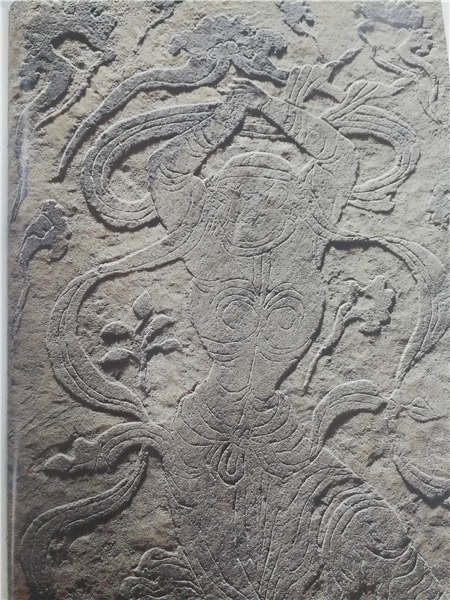
A Tang Dynasty stone tomb gate carved with images of Sogdian dancers [Photo provided to China Daily] |
Sogdian elements were introduced into the final resting place of their contemporary Chinese, not only in the forms of ceramic sculptures and murals.
"The Sogdians were cast not only as servants and entertainers, but also as retinues and protectors," Mao says, referring to a clay sculpture that used to guard the entrance to a Tang Dynasty tomb in Xi'an.
The tomb guards, indispensable for ancient Chinese burial grounds, usually took their images from ferocious animals, real or mythical. But this particular one has the pricked ears of a horse, the spiky wings of a unicorn, the stout legs of a lion and the fierce face of a Sogdian man.
We should not be surprised, says Sun Ji, a Chinese historian.
"Long under the rule of Xiongnu, the Sogdians themselves, although vulnerable in a way, also developed a tough side."
Needless to say, the long journey they took, often under unpredictable circumstances, also helped to inject a dose of hardiness into the Sogdian blood.
Thus came another profession of the Sogdians: to serve as mercenary soldiers among foreign troops, including that of Tang. And with deepened influence the Sogdians exerted over the Chinese empire in the seventh and eighth centuries, their presence in the Tang army took on a new dimension during the reign of Emperor Xuanzong (685-762).
"That was when, after nearly a century after the founding of Tang in 618, the fighting capacity of its troops had greatly dwindled," Sun wrote in an article. "At some point it was suggested to the emperor that the introduction of Sogdians as not only ordinary soldiers but also generals might provide a solution."
The emperor took the advice, and a couple of decades after the death of An Pu his men were enjoying a higher political profile.Among them was An Lushan, no relation to An Pu, a Sogdian general stationed in what is today northeastern China. Having won the total trust of Emperor Xuanzong and his beloved concubine Yang Yuhuan, An Lushan, who was given more military power than any of his Sogdian predecessors, rebelled. One direct result was Xuanzong's fleeing from his royal palaces in Xi'an, palaces later sacked by the rebel troops. Another was the forced suicide of Yang during their escape, by angry soldiers who accused her of having fostered nepotism and misled the emperor.