Love and loathing from the footnotes of history
By Zhao Xu( China Daily )
Updated: 2018-11-26
 |
|
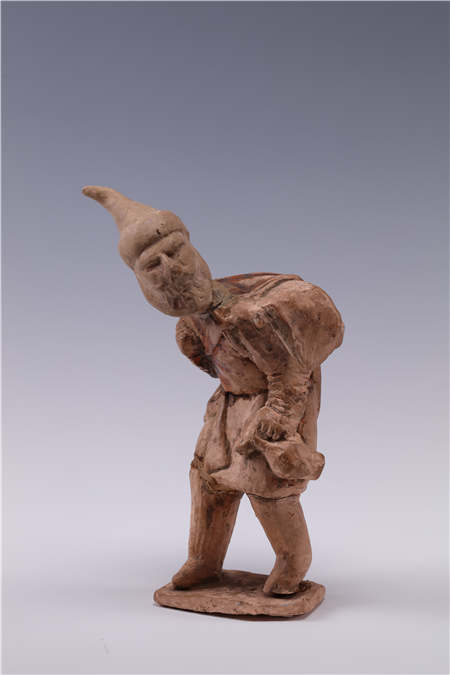
Tang Dynasty clay figurine of a Sogdian merchant, within the collection of Luoyang Museum [Photo provided to China Daily] |
Given that the Sogdians were first and foremost businessmen, this assessment may not be entirely groundless. However, local Chinese also found the Sogdian practice of consanguineous marriage deeply disturbing, Sun says. (It is true that until the early 20th century it was perfectly normal for a Chinese to marry his or her cousin. But if the writings between the sixth and the eighth centuries are to be believed, it was acceptable for a Sogdian to marry his blood sister or even mother.)
Adding to this were the Sogdians' unconventional funerary traditions, which involved having the remains of the dead eaten by dogs. (Similar practices can be found in what is known as the "sky burial" of the Tibetans, whereby a human corpse is placed on a mountaintop to decompose or to be eaten by scavenging animals, mostly carrion birds. But if there is any concrete connection between the two it has yet to be established.)
Consequently, although during the Tang era, especially its first half, the Sogdians had a prominent place in the life of the local Chinese, marriages between the two people were rare.
Personal sphere aside, this tinted view did little to prevent the Sogdians making inroads into almost all other aspects of Chinese society, thanks in equal part to their great adaptability and the many skills they had acquired by tradition or by learning.
One of these was what seemed to be their natural prowess in dance and music, which largely explains the popularity of Sogdian servants among the wealthy elite of Tang. (Some of them were men of magic, as a pottery figurine unearthed in Gansu province, northwestern China, clearly indicates. With both hands hidden behind his back, the man, whose high-bridged nose and thick beard revealed him as a Sogdian, was in the middle of playing finger tricks.)
Images of Sogdian musicians and dancers, rendered mostly as pottery figurines or on murals, abound in Tang Dynasty tombs, testifying to a willingness of the local Chinese to be entertained by the same people in their afterlife.
Some were also chiseled onto the gilt surface of various metal wares that bore the unmistakable influences from West Asia, influences brought by the Sogdians themselves and representing a more profound aspect of Silk Road exchanges.
In other cases the likeness of a Sogdian served unlikely functions, in a rather amusing way, for example as a pottery granary stopper or a box lid.
Rong Xinjiang, a professor of history at Peking University, says many Sogdian men served as metalsmiths in the imperial workshops of Tang. But rather sadly, very little of their craftsmanship was later passed down to their Chinese counterparts, a fact that some historians believe was partly due to Chinese society's deeply entrenched bias against artisans. They were viewed as lesser mortals compared with the literati. So there was little effort in Chinese history to record and preserve what they were doing.
Between the fourth and 10th centuries the Sogdian dominance of the Silk Road in effect turned their Eastern Iranian language into a lingua franca of Asian trade. On the other hand, their role as middlemen had given them a unique linguistic edge from a relatively young age; most Sogdian merchants were proficient in more than one tongue.