Love and loathing from the footnotes of history
By Zhao Xu( China Daily )
Updated: 2018-11-26
 |
|
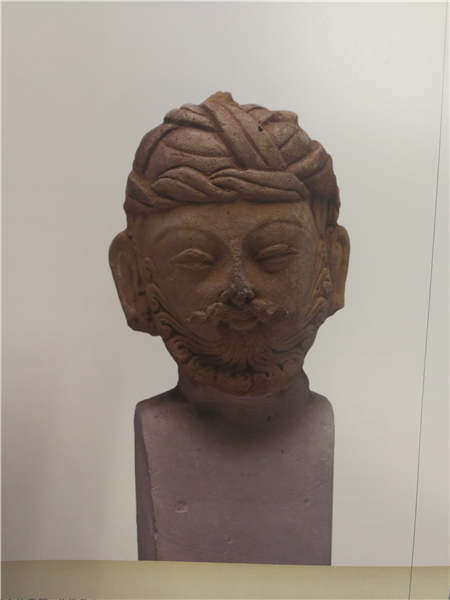
Tang Dynasty clay head sculpture of a Sogdian donor, unearthed in Xinjiang [Photo provided to China Daily] |
As a result, many well-educated members of the group were recruited by the Tang court as official interpreters. There were also others who converted to Buddhism and were active in translating religious scriptures.
"In retrospect, this latter engagement spared the ancient Sogdian language - at least its written form - the fate of total extinction," Rong says. "By comparing the original scripture with the Sogdian translation, historians have been able to decipher a large part of the archaic tongue."
One place where these precious documents used to be housed, Rong says, is in the Dunhuang Grottoes in northwestern China, whose 500 or so caves are treasure troves of Buddhist art. The Sogdian translations have been found in one particular cave, where the dry desert climate combined with a lack of oxygen have contributed to their remaining relatively intact.
"In fact the Sogdians played a major role in religious transmission along the Silk Road, a role often overlooked," Rong says. "They helped to bring to China the Buddhist religion, which reached its height during the Tang time, and in this process themselves converted, from their original belief of Zoroastrianism."
Archaeological discoveries provide evidence for the conversion. Unearthed in the Buddhist shrine in Xinjiang, northwestern China, is a clay head sculpture of a Sogdian gongyangren, or donor. Bearing in mind the wealth they accumulated in trade, it is not surprising that some of that wealth was offered up to temples of worship.Another example involves a gilt bronze rendition of a Sogdian performer, leaping and twirling on top of an inverted lotus flower. The dance is purely Sogdian, but the flower, on which Avalokitasvara, or the Goddess of Mercy, is often seated, is commonly viewed as a symbol of Buddhism. (It should be noted that there were also Sogdians who took up Christianity and as the earliest Christian believers in China helped to disseminate their religious message in their adopted home.)
Changes took place not only in the religious sphere, Rong says.
"The two-way influence between the Sogdians and the local Chinese are encompassing to say the least. And there's no better place to observe this than the inside of their burial chambers.
"So far, no pre-fifth century Sogdian tombs have been discovered, for clear reasons: people at the time still preferred the aforementioned organic way of dealing with their bodies, a practice closely related to Zoroastrianism. However, stone-inscribed epitaphs for Sogdians started to appear in China around the late sixth century, a telltale sign of their gradual cultural conversion."
Mao of Luoyang Normal University says that almost all Sogdian tombs discovered in Luoyang have stone epitaphs - the wooden coffins have long rotted and been reduced to traces on the ground.
"Some epitaphs are dedicated simultaneously to the husband and wife."