 |
|
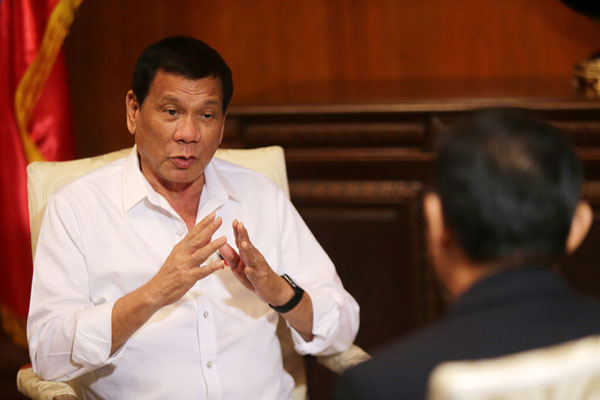
Philippine President Rodrigo Duterte (L) speaks during an interview with Xinhua News Agency in Manila, the Philippines, Oct 13, 2016. [Photo/Xinhua] |
The Philippines and the United States began their main annual military exercises on Monday on a low key and a limited scale. The 12-day "Balikatan", or "shoulder to shoulder", joint military drills could serve as a barometer of the decades-old alliance. Some media reports say the number of troops taking part in this year's drills is less than half that in 2015, and the focus is only on anti-terrorism and disaster-response operations-in sharp contrast to the drills held when Benigno Aquino III was the Philippine president.
The "shoulder to shoulder" war games, begun in 1991, have been held almost regularly except for the brief interruption between 1995 and 1999. In recent years, many observers saw the annual exercises as a strategic maneuvering of former US president Barack Obama to push forward his "rebalancing to Asia" strategy. The military drills even served Aquino III's ulterior motive of confronting China over the South China Sea disputes and using it as a pretext to strengthen the Philippines' maritime defense and combat capabilities. And the drills, as expected, raised tensions in the region as they were staged near disputed waters.
However, Philippine President Rodrigo Duterte has sought to improve ties with China after taking office and play down the importance of his country's alliance with the United States. Duterte has also made some unfriendly remarks against the US, raising a lot of eyebrows in Washington and other Western capitals.
Yet the Donald Trump administration has been restrained in its response to Duterte's somewhat provocative rhetoric and instead has tried to shore it up as one of the most important alliances for the US in the Asia-Pacific region.
After Duterte announced in September that he would soon stop holding joint military drills, US Defense Secretary Ashton Carter, in an apparent response, said Washington's alliance with Manila remains "ironclad".
Although Trump is yet to reveal a policy to replace the "rebalancing to Asia" strategy, the US is unlikely to play down the importance of the Philippines in the Asia-Pacific as the latter will assume the rotating chair of the Association of Southeast Asian Nations this year. But it would be na?ve of the US to still believe Manila will be happy to propel the US' strategic maneuvering in the region just like it did during Aquino III's tenure.
For its part, the Philippines under Duterte is unlikely to change its policy of gradually distancing itself from the US. That Washington and Manila, at their annual strategic meeting in November, agreed to scale back their joint exercises and reduce the number of US troops deployed in the Philippines is one example of Manila sticking to its course. Philippine officials said the scaled-down drills include an amphibious landing exercise and cooperation afloat readiness and training, both major naval exercises that include territorial defense training.
Although it might be too early to speculate the slow weakening of the US-Philippines alliance, one can safely say a light breeze of change is blowing, especially because the uncertainties that have emerged might not be bad for Manila and the South China Sea disputes. After all, the Philippines did not get any substantial gains for becoming a leading catalyst for the US' "rebalancing to Asia" strategy while suffering all the negative consequences of its soured relations with Beijing. Duterte realized this inequity before deciding to develop better relations with China. The Philippine president will visit China to attend the Belt and Road Forum for International Cooperation in Beijing on May 14 and 15. His second visit to China since taking office in July shows his determination to deepen ties with China.
China-Philippines ties are back on the right track, and the two sides have signed an array of bilateral agreements of cooperation that will bring mutual benefit. And tensions in the South China Sea have defused as Manila gradually distances itself from Washington. Some times even a light breeze makes the wind chimes produce clear, melodious music.
The author is a senior writer with China Daily. wanghui@chinadaily.com.cn



Last weekend, I was hanging out downtown with a friend and my sister. We were walking through a public spare when all of a sudden a heated argument between a student and a middle-aged woman arrested our attention.
Copyright 1995 - . All rights reserved. The content (including but not limited to text, photo, multimedia information, etc) published in this site belongs to China Daily Information Co (CDIC). Without written authorization from CDIC, such content shall not be republished or used in any form. Note: Browsers with 1024*768 or higher resolution are suggested for this site.
License for publishing multimedia online 0108263 Registration Number: 130349