 |
|
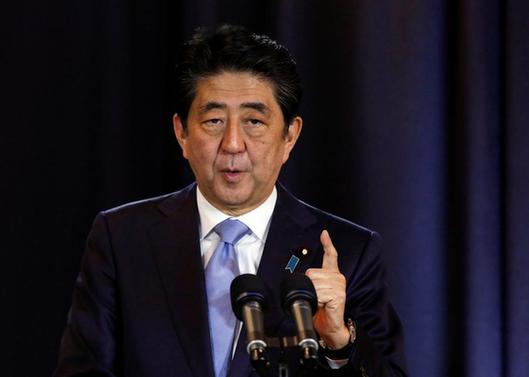
Japanese Prime Minister Shinzo Abe gestures during a press conference in Buenos Aires, Argentina, November 21, 2016. [Agencies] |
Japanese Prime Minister Shinzo Abe has waited for the right time to show his hand. And the Democratic People's Republic of Korea, by test-firing missiles and threatening to conduct another nuclear test, has given Abe the ruse.
Abe has finally unveiled his timetable for giving "a newly reborn Japan" a new Constitution: 2020. His announcement came on Wednesday when the country observed the 70th anniversary of the Constitution that unequivocally renounces war as a sovereign right of Japan and the threat to use or the use of force as means of settling international disputes.
Addressing fellow conservative lawmakers, Abe said Article 9 needs to be amended in order to include a provision to give Japan's current quasi-army, the Self-Defense Forces, a constitutional status. And he claimed it was one of his generation's missions to make the SDF "constitutional".
Even though the Constitution prohibits Japan from having armed forces, the country built a military in the form of the SDF at the beginning of the Cold War.
Abe also intends to introduce an "emergency" clause to the new Constitution that would give Japanese leaders the authority to respond to large-scale "disasters".
The Yomiuri Shimbun supports Abe, using the DPRK's recent repeated military provocations and China's "self-righteous" maritime advances and military buildup as the justification for redefining the SDF.
The Asahi Shimbun, however, maintains that Japan could achieve peace and prosperity through the current Constitution, because its fundamental principles, such as sovereignty of the people, respect for human rights and pacifism, have functioned well so far. The Asahi Shimbun also warns that the Constitution now faces its gravest crisis, with the supreme charter being seriously abused under the Abe administration, which has overturned the Japanese government's traditional interpretation of the constitutional law that the right to collective self-defense cannot be exercised without amending the war-renouncing Article 9.
Moreover, the Abe administration has railroaded the security legislation through parliament allowing Japan to defend its allies overseas even when it is not under attack.
To showcase this breakthrough, the Japanese government, for the first time, sent the country's biggest warship Izumo on May 1 to escort a US Navy's supplier ship to join the US' military campaign to put pressure on the DPRK, without seeking approval of the Japanese parliament.
The Japanese media reported that the government had initially planned such a mission for Japanese warships to take part in the Japan-US joint exercises in autumn. The Abe administration's painstaking efforts to hype up the threats from Japan's neighbors seem to have paid off, because the almost anti-militarist movement in Japan has lost momentum, as seen in the public's changing attitude toward constitutional revision. A recent opinion poll conducted by the Mainichi Shimbun showed that some 48 percent of Japanese voters believe the Constitution should be amended, compared with 42 percent supporting constitutional amendment last year.
Japan is scheduled to hold elections to the lower house of parliament in December 2018, and the leader of the winning party will become the new prime minister of the country. But no natural rival to the ruling Liberal Democratic Party has emerged until now.
The LDP has also changed its rules, allowing its leaders to serve a third consecutive term, which could give Abe, whose second consecutive term as the party's leader will end in September 2018, a better chance of serving as Japan's prime minister beyond 2020.
The Japanese Constitution "represents the shape of our country, and it should describe Japan's ideal future," Abe told the LDP's annual convention on March 5, making it clear that he aims to unchain Japan from the post-World War II regime.
The author is China Daily Tokyo bureau chief.
caihong@chinadaily.com.cn

Copyright 1995 - . All rights reserved. The content (including but not limited to text, photo, multimedia information, etc) published in this site belongs to China Daily Information Co (CDIC). Without written authorization from CDIC, such content shall not be republished or used in any form. Note: Browsers with 1024*768 or higher resolution are suggested for this site.
License for publishing multimedia online 0108263 Registration Number: 130349