Pollution is a scourge in China, the debilitating consequences of unbridled industrial growth. But how can China halt and reverse such devastation without undermining economic growth? For China to achieve its goal of becoming a "moderately prosperous society," this question must be answered.
One of the pioneers in seeking answers to this question has been the coastal province of Zhejiang in East China, where environmental protection had been sacrificed on the altar of economic growth. To begin its environmental healing, the Zhejiang government shut down thousands of polluting workshops and restricted heavy industries such as mining and papermaking. What happened to the economy as a result?
To find out, I went to Zhejiang, where I discovered that Anji county in Zhejiang's mountains has been transforming itself from a polluted mining area into a "green center" of ecology-friendly agriculture, industry and tourism.
In 2003-05, the county closed three mining companies and a cement factory in Yu village, consequently the village's GDP fell from over 3 million yuan ($449,842) to only 200,000 yuan, a drop of 93 percent.
Fortunately, the area has rich resources of bamboo and local residents began making money in an eco-friendly way. Today, Anji produces over 3,000 bamboo products, from underwear to home furnishings, that generate revenues of 18 billion yuan ($2.7 billion) a year, making Anji the world leader for bamboo products.
President Xi Jinping was the Party secretary of Zhejiang between 2002 and 2007, and he promoted green development. Back in 2006, when I met Xi in the provincial capital Hangzhou, he stressed the importance of Zhejiang's forests.
And speaking in Yu village in 2005, Xi famously said, "We must get rid of the old development mode. In the past, we said we wanted clear waters and green mountains and we wanted mountains of gold and silver at the same time. In fact, clear rivers and green mountains are mountains of gold and silver."
Putting theory into practice, Zhejiang has pioneered an "eco-compensation" system which enables environmental preservation and facilitates eco-friendly industries by transferring funds based on the meeting of certain standards for water quality, forest size, and the like.
For instance, the Xin'an River flows into Qiandao Lake from neighboring Anhui province, which is the source of most of the pollutants in the water. But why would Anhui, a less developed province, pay to improve the environment of Zhejiang, a more developed province?
To settle their dispute, in 2012, the parties developed an "eco-compensation" framework. Under this mechanism, if the water from Anhui attains a mutually agreed standard, Zhejiang pays Anhui 500 million yuan. If it doesn't meet the standard, then Anhui pays Zhejiang that amount.
Zhejiang's eco-compensation system is an innovative idea - a new way of thinking - to help solve what once seemed like an intractable problem.
Environmental protection is now a priority in China. Green development is the third of the Five Major Development Concepts put forward by Xi Jinping, and the government has instituted tougher environmental protection laws and is showing greater determination to enforce them. There are now no caps on the penalties levied for pollution, and NGOs as well as regulators can take legal action against corporate violators. Even the public can monitor polluting firms.
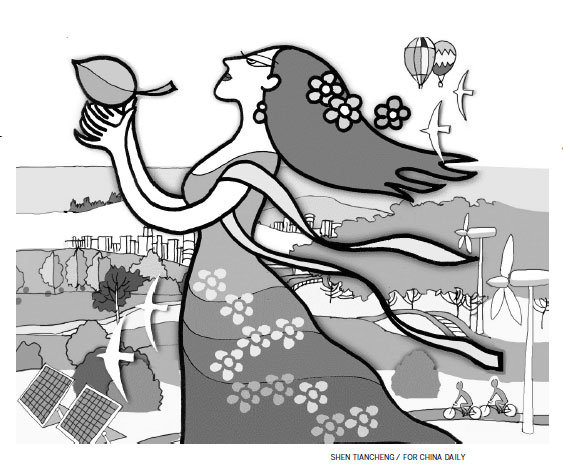
Unless China's environment is cleaned up, the Chinese dream will not be achieved, because if its environment remains massively polluted the Chinese nation will not be rejuvenated. For the first time in China's history, green development has been elevated to highest national importance.
The author is a public intellectual, political/economics commentator, and an international corporate strategist. He is also host of Closer to China with R.L. Kuhn, a weekly show on CCTV News (Sundays 9:30 am and 9:30 pm).
(China Daily 10/15/2016 page5)



Copyright 1995 - . All rights reserved. The content (including but not limited to text, photo, multimedia information, etc) published in this site belongs to China Daily Information Co (CDIC). Without written authorization from CDIC, such content shall not be republished or used in any form. Note: Browsers with 1024*768 or higher resolution are suggested for this site.
License for publishing multimedia online 0108263 Registration Number: 130349