|
 |
|
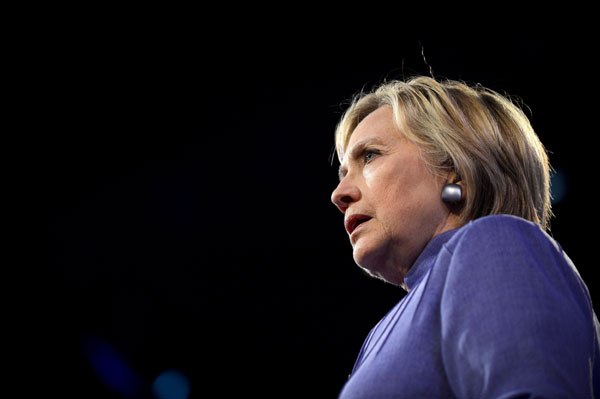
Democratic presidential nominee Hillary Clinton addresses the National Convention of the American Legion in Cincinnati, Ohio, US, August 31, 2016. [Photo/Agencies] |
The great paradox in the last few months of the US presidential election campaign is that American democracy has been weakening the post WWII alliance system as well as a central plank of the pivot to Asia, the TPP. By saying the US might cast off the burden of allies, Donald Trump has already made leaders in Japan, South Korea and the Philippines anxious. Rodrigo Duterte, the Philippine president, surely only says what many are thinking when he doubts American staying power and recognizes he must forge a relationship with China. And it should be noted that, whatever else may be repulsive about Trump, the idea of shedding and sharing the burden with America’s allies resonates with the public, both with respect to alliance commitments in Europe and Asia.
China, however, should be careful what it aims for in this regard – it could end up producing a nuclear Japan sooner rather than later if Trump were to win and America’s defense umbrella of Japan were to be removed. No present security arrangements in the region should be dismantled until more inclusive architecture is in place. A vacuum would be dangerous for everyone.
Both Donald Trump and Hillary Clinton, under pressure from the left, have condemned the TPP, which was the centerpiece of the idea of an “economic NATO” that would cement new trading architecture for East Asia that would put China on the sidelines. Singapore has signaled that a failure to see through TPP, which leaders in Japan agreed to at great political cost by overriding its rice farmers, will make allies doubt America’s clout. A failure of TPP would grant China more space to shape the rules in the region.
In short, the American pivot has been sent on a detour, if not knocked off course, by a disgruntled American public. This raises an even larger question: Can democracy be counted on to keep its commitments? This may also be true with respect to the climate change accord signed by the US and China – 28 American states are trying to kill Obama’s linchpin Clean Power Act in the courts.
If Hillary Clinton wins, her stated foreign policy aim is to maintain America’s global leadership. At the same time, no responsible leader, her national security team has made clear, wants a weak China. That is not in America’s interest, or the world’s interest. If China’s ambitions need to be challenged, her team has said, it would be through bolstering its allies.
On this score, the US has to be careful not to over-reach given the growing wariness of those allies concerning America’s long-term commitment. As George Yeo, Singapore’s former foreign minister, has said, “Asian nations can be friends of America, but they can’t afford to be enemies of China.”
Overall, a new Clinton administration would oppose the idea of “Asia for Asians.” It wants a “pan-Pacific order, not an Asian order.” The idea is more to maintain America’s presence, not contain China.
As Peking University scholar Wang Jisi has recently written, the “new normal” of relations between China and the US is a contest over writing these rules of the future order, both in trade and security.



Copyright 1995 - . All rights reserved. The content (including but not limited to text, photo, multimedia information, etc) published in this site belongs to China Daily Information Co (CDIC). Without written authorization from CDIC, such content shall not be republished or used in any form. Note: Browsers with 1024*768 or higher resolution are suggested for this site.
License for publishing multimedia online 0108263 Registration Number: 130349