 |
|
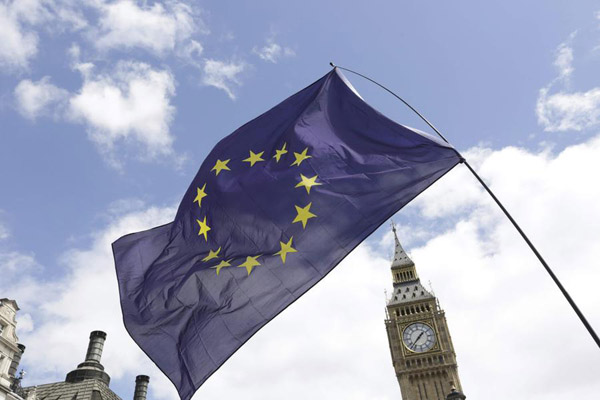
A European Union flag is held in front of the Big Ben clock tower in Parliament Square during a 'March for Europe' demonstration against Britain's decision to leave the European Union, central London, Britain July 2, 2016.[Photo/Agencies] |
While seemingly elegant in theory, globalization suffers in practice. That is the lesson of Brexit and of the rise of Donald Trump in the United States.
Truth be known, there is no rigorous theory of globalization. The best that economists can offer is David Ricardo's early 19th century framework: if a country simply produces in accordance with its comparative advantage (in terms of resource endowments and workers' skills), presto, it will gain through increased cross-border trade.
Trade liberalization-the elixir of globalization-promises benefits for all. That promise arguably holds in the long run, but a far tougher reality check invariably occurs in the short term. Brexit is just the latest case in point.
Voters in Britain objected to several of the key premises of European integration: free labor mobility and seemingly open-ended immigration, regulation by supranational European Union authorities, and currency union (which has serious flaws, such as the lack of a fiscal transfer mechanism among member states). Economic integration and globalization are not exactly the same thing, but they rest on the same Ricardian principles of trade liberalization-principles that are falling on deaf ears in the political arena.
In short, globalization has lost its political support-unsurprising in a world that bears little resemblance to Ricardo's two centuries ago-and therefore Ricardian principles seem irrelevant today. Paul Samuelson, who led the way in translating Ricardian foundations into modern economics, reached a similar conclusion late in his life, when he pointed out how a low-wage technology imitator like China could turn the theory of comparative advantage inside out.
But it is not just a problem with an antiquated theory. Recent trends in global trade are also flashing warning signs. According to the International Monetary Fund, annual growth in world trade volume has averaged just 3 percent over the 2009-16 period-h(huán)alf of that from 1980 to 2008. With world trade shifting to a decidedly lower trajectory, political resistance to globalization has only intensified.
Globalization has run into trouble even before. Globalization 1.0-the surge in global trade and international capital flows in the late 19th and early 20th centuries-met its demise between World War I and the Great Depression. Global trade fell by some 60 percent from 1929 to 1932, as major economies turned inward and embraced protectionist trade policies, such as the US' infamous Smoot-Hawley Tariff Act of 1930.



Copyright 1995 - . All rights reserved. The content (including but not limited to text, photo, multimedia information, etc) published in this site belongs to China Daily Information Co (CDIC). Without written authorization from CDIC, such content shall not be republished or used in any form. Note: Browsers with 1024*768 or higher resolution are suggested for this site.
License for publishing multimedia online 0108263 Registration Number: 130349