 |
|
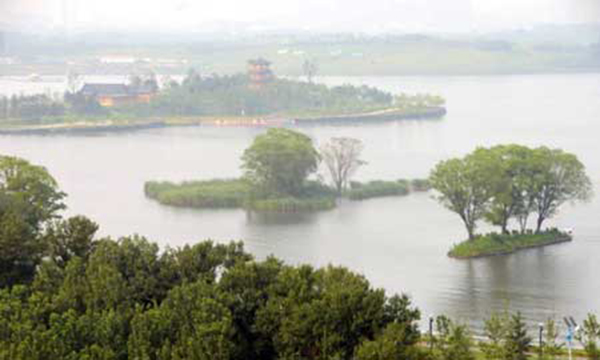
Photo taken on July 13, 2010 shows the scene of South Lake Park in Tangshan, north China's Hebei Province. The government of Tangshan transformed the South Lake from waste landfill to ecological park. [Xinhua] |
Chinese cities are experiencing a surge in illegal dumping of demolished building materials. Even the standard six-story apartment blocks built in the 1960s average six truckloads of waste for every two-bedroom apartment, or thousands of truckloads for clearing an old residential complex.
As an expert in "material balance", Ma Zhong, dean of environment school at Renmin University of China, teaches and preaches against the ignorance of assuming that waste is going to disappear, especially if an average old suburb has enough cubic meters of damaged bricks, cement and rusted iron rods and plates to build a pyramid.
Transporting waste is all cost and no profit. So clearing rubble can mean midnight dumping just across your line of responsibility in the next suburb or county. Dumped piles of debris make roadsides ugly and hazardous.
Chen Bin, a professor at Beijing Normal University's environment school, says so much architectural creativity and thousands of hours' work go into the planning of buildings but none into their eventual demolition and clearance. When buildings outlast their utility, they are usually demolished (often replaced by grander structures). And removal of rubbish requires little science and skill, and often no license or plan.
In a typical case, a 10-ton truck full of crumbled concrete and twisted iron rods is dispatched to a theoretically approved landfill. The contract driver of the truck is from a place far away from the city where he works, and he is tired. You can guess the rest. The drivers next in line, too, can guess-and if the first gets away with illegally dumping the rubble those following him may do the same. This is happening on a widening scale across administrative borders between neighboring cities.
All modern countries are experiencing this pressure of figuring out where to dump the downside of urban development. The Kowloon Walled City in Hong Kong festered into grime and crime, and eventually it had to be leveled in the 1990s. But the rubble was not dumped across the border on that occasion.
In the United States, a contractor saddled with clearing a Las Vegas casino implosion thought he had an easy solution. He brazenly negotiated to landfill a nearby Indian reservation. When challenged his retort borrowed from Indian folklore-when you take from the land you ought to give something back. This seems to be the story across the world, and rubble trouble seems to be legislated only after it has spread.
Singapore, a small city state, had to solve its demolition dilemma within a short time. But it turned the challenge into a brilliant opportunity, using the landfill for expansion of its meager land area. Derision of building on a scrap heap has turned to admiration, thanks to careful scientific management of potential pollutants. A 7-km perimeter of solid material secured Semakau Island as a safe place to deposit urban waste and it is nurturing a green ecology as it progresses, and being only 8 km from Singapore it is easy to transport solid waste each night in covered barges.
China's shoreline also offers locations for expanding landfills, along with the natural silt deposits of the Yellow River that has extended to 20 km since 1978. A more practical use of construction rubble may be for highways and railways that need to be elevated a few meters. Logical planning can make urban development eco-friendly, and now that the landfill problem is spilling over from one city to another, environmental scientists need to be advising governments on pro-active strategies. Ma and his peers can apply "material balance" accounting to calculate how much rubble will be produced in demolitions and where and how to use them. Otherwise these urban eyesores will not so slowly turn into environmental wastelands.
The author is a fellow at the Environment Futures Research Institute, Griffith University, Australia.



Copyright 1995 - . All rights reserved. The content (including but not limited to text, photo, multimedia information, etc) published in this site belongs to China Daily Information Co (CDIC). Without written authorization from CDIC, such content shall not be republished or used in any form. Note: Browsers with 1024*768 or higher resolution are suggested for this site.
License for publishing multimedia online 0108263 Registration Number: 130349