 |
|
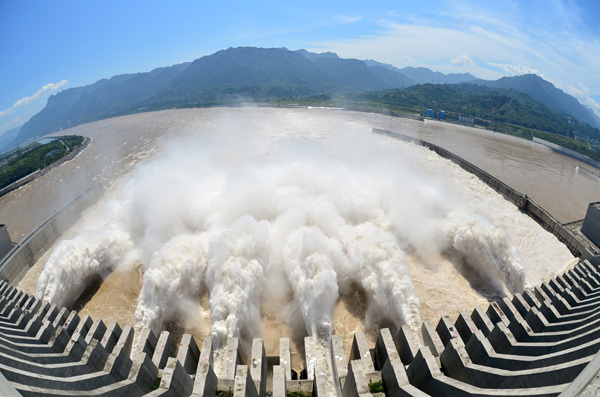
The sluice gates of the Three Gorges Dam. [Photo/Xinhua] |
Torrential rainfall has hit provinces in the lower reaches of the Yangtze River with water levels rising above the danger level at almost all places. This has prompted many to wonder whether the Three Gorges Project on the Yangtze River is serving its purpose, of alleviating, even preventing natural disasters. There are even rumors that the dam could increase the frequency of geological disasters.
But an undeniable fact is that the Three Gorges Dam has prevented heavy storms and floods from hitting areas in the downstream of the Yangtze River. The El Nino phenomenon this year, which would result in heavy storms in China's southern provinces and serious droughts in Southeast and South Asia and South America, has much to do with the high and still increasing carbon emissions worldwide.
As the largest hydropower project in the world, the Three Gorges Dam is helping reduce carbon emission by generating electricity from water instead of fossil fuel. It generates about 100 billion kilowatt hours a year, which means it is saving 50 million tons of steam coal and cutting carbon dioxide emission by about 100 million tons. For a better perspective, the world's total CO2 emission was 32.3 billion tons in 2014, suggesting the Three Gorges Project can save about 0.3 percent of global CO2 emission.
The Three Gorges Dam has its deficiencies, though. Its storage capacity is not large enough, which limits its capability to adjust the water flow in the Yangtze River. Despite being the world's hydropower project, its reservoir (39.3 billion cubic meters) ranks 22nd globally. The reservoir is rather small compared with the runoff of the Yangtze River, which is 3,100 cu m per second. The Aswan Dam, the largest in the world, on the Nile River in Egypt has a storage capacity of 168.9 billion cu m while its runoff is only 2,830 cu m per second. And the Hoover Dam in the United States has a storage capacity of about 34.8 billion cubic meters while its runoff is only 311 cu m per second.
The Three Gorges Dam's relatively small reservoir has seriously affected its ability to adjust the flow of water in the Yangtze River and thus prevent floods from occurring downstream.
In fact, small reservoirs are a common problem with China's dams. Capacity coefficient, or the water storage capacity divided by the average runoff for the passing decades, is an important index of the performance of a reservoir. The average coefficient for reservoirs in Europe and the US is about 0.9 and 0.66, whereas in China it is only slightly above 0.3.
Reservoirs in China are small compared with those in Europe and the US mainly because of limited availability of land. Take the Three Gorges Dam for example. To expand the project, the government would have needed to buy more land along the upper reaches of the river and help more immigrants resettle in other provinces. Besides, the land in the upper reaches of the Three Gorges Dam is mountainous, and it would have cost huge amounts of money and labor to expand the reservoir there. That's why the Three Gorges Dam was built following the principle of best performance at a given cost.
Chinese engineers are trying to find ways of building multiple reservoirs on the same river. For example, experts and officials are discussing an ambitious plan to build another reservoir in the upper reaches of the Yangtze River at Hutiao Gorge in Southwestern China's Yunnan province, and the designed storage capacity would be about 30 billion cu m, comparable to that of the Three Gorges. If the plan becomes reality, floods in the Yangtze River can be further curbed — even in case of extreme weather, it will be easier to control the water flow.
So we should view the Three Gorges Dam as it is. Its job is to help fight climate change by cutting carbon emission, and curb floods in downstream provinces by adjusting the water flow in the Yangtze River. But it alone cannot solve all the problems. There is still a huge gap between China's water conservancy projects and those in Europe and the US, and it will take some time for China to catch up with them.
Zhang Boting is a senior researcher at the China Society for Hydropower Engineering. The article is an excerpt from his interview with China Daily's Zhang Zhouxiang.



Copyright 1995 - . All rights reserved. The content (including but not limited to text, photo, multimedia information, etc) published in this site belongs to China Daily Information Co (CDIC). Without written authorization from CDIC, such content shall not be republished or used in any form. Note: Browsers with 1024*768 or higher resolution are suggested for this site.
License for publishing multimedia online 0108263 Registration Number: 130349