 |
|
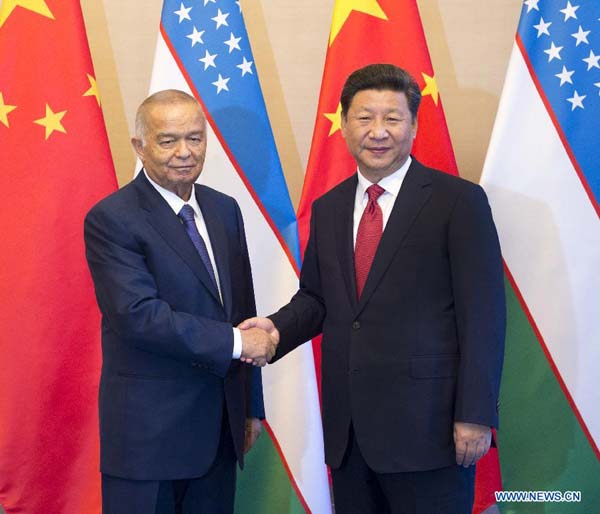
Chinese President Xi Jinping (R) meets with President of Uzbekistan Islam Karimov in Beijing, Sept. 2, 2015.[Photo/Xinhua] |
When Xi Jinping launched the Belt and Road Initiative (BRI) in a pair of speeches in September and October 2013, it was clear that at the forefront of his mind was the need to further develop China's links – economic, political and cultural – with the Central Asian states (Kazakhstan, Kyrgyzstan, Tajikistan and Uzbekistan) which, along with Russia and China itself, form the membership of the Shanghai Cooperation Organization (SCO).
It is no random event that the first of these two speeches, which outlined Xi's vision for a 'Silk Road Economic Belt' (SREB) stretching via land from East Asia to Europe, was given at Nazarbayev University in Astana, Kazakhstan. The other, concerning the 21st Century Maritime Silk Road, was given in Indonesia one month later, demonstrating the intent to link land and sea routes in a wide-ranging trade, transport and infrastructure network, the BRI (also called 'One Belt, One Road' (OBOR)), which is meant to connect all corners of the Eurasian landmass with each other as well as with Africa.
On land, the SREB is supposed to stretch via rail and road links from China's east coast all the way to Germany and Spain via Central Asia and the Middle East. At sea, the 'Maritime Silk Road' is intended to connect the Pacific with the Indian Ocean, the Mediterranean and the Baltic in a network of shipping routes which are to be integrated with the overland routes of the SREB.
China's president made clear, even at the launching of the BRI initiative, that Central Asian states were key players in his grand plan. After all, Central Asia lies directly on the path between East Asia and Western Europe, directly astride the ancient Silk Road whose name has been taken for the new initiative. Without close cooperation between the Central Asian states and China, neither the SREB nor the overarching BRI within which it is to be placed can come to fruition.
Xi also explained in his September 2013 speech that the SREB is to be based on the work done within the SCO framework to establish closer ties between the six founding members since the founding of the group in 2001. Nobody is in any doubt that the SCO has been remarkably successful in cementing political and economic relationships between its members since its inception. As a result, the organization has begun to alter the geo-economic and geopolitical landscape of Central Asia in what some observers have termed a 'new great game'.
One consequence of the growing impact of the SCO on international relations has been that a number of other countries have sought either to join the organization, to observe its discussions, or to become dialogue partners. Most notably, Pakistan and?India?are due to be accepted into the SCO ranks at some point in 2016. Other significant local players such as Iran, Turkey, Azerbaijan and Armenia are waiting in the wings, monitoring developments.
As regards Uzbekistan, which is hosting the latest round of talks between heads of state within the SCO framework, this nation is clearly a key partner for China in Central Asia, not only in terms of transport connections, but also in terms of trade and natural resources. Uzbekistan has large gold and uranium deposits, meaning that the state-owned Navoi Mining and Metallurgy Combinat is one of the world's ten largest producers of these commodities. Uzbekistan also has considerable oil and natural gas reserves. China National Petroleum Corporation has been working in conjunction with Uzbekneftegaz, Uzbekistan's national oil and gas company, to develop oil fields in the country since 2006. The Central Asia-China gas pipeline, vital for China’s natural gas supplies, runs through Uzbekistan via three pipelines, while a fourth is under construction.
All of these facts mean that President Xi's visit to Tashkent for the latest round of talks on June 23-24 is far from ceremonial. Uzbekistan, Central Asia and the steadily expanding SCO all constitute vital cogs in Xi's vision of a new interconnected Asia-to-Europe economic zone unified under Chinese leadership. Consequently, the latest meeting of the SCO in Uzbekistan is likely to be followed with interest by both experts and lay observers alike.



Copyright 1995 - . All rights reserved. The content (including but not limited to text, photo, multimedia information, etc) published in this site belongs to China Daily Information Co (CDIC). Without written authorization from CDIC, such content shall not be republished or used in any form. Note: Browsers with 1024*768 or higher resolution are suggested for this site.
License for publishing multimedia online 0108263 Registration Number: 130349