 |
|
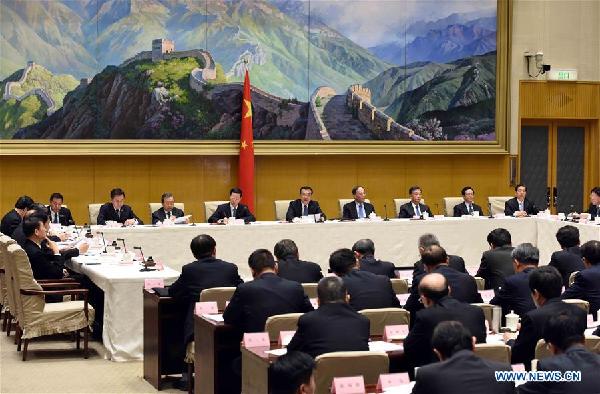
Chinese PremierLi Keqiangspeaks during the fourth meeting on clean governance in Beijing, March 28, 2016. [Photo/Xinhua] |
In China, governance refers to the action, manner and power of governing, for which a good political system and good political order are needed.
China's understanding of national governance not only reflects the traditional Chinese political concept that integrates society and politics, but also combines contemporary international political concepts and practices, which include multi-subject and polycentric management of public affairs.
The modernization of the governance system for the rejuvenation of the Chinese nation is the "fifth modernization" that the country has embarked upon, following the comprehensive modernization of agriculture, industry, national defense and science and technology. It is also a pilot exploration of national governance in the modern sense of the term.
Many developed countries face the governance problem: how to determine the state's role amid the risks posed by information technology, post-industrialization, mass migrations and cross-border. This is also crucial for modernizing the national governance system.
In developed countries in the West, national governance has undergone three centuries of development. Thanks to this process, they can claim to be practicing modern governance that ensures more equality in gender, race, voting rights and free expression, and connects with the implementation of representative political system. This has also helped form a vertical channel and elastic political structure between politics and society.
The long-term goal of China's political development is to establish socialist democratic politics that coordinate the development of different fields and is based on Chinese tradition and culture. And promoting modern governance is the aim of China's long-term political development.
The exploration of modern national governance is the process of exploring the institutionalization of domestic political and social order in the era of globalization. It is also a process of incessant coordination among the three major fields-politics, market and society.
The institutionalization process is unlikely to be achieved spontaneously. It is more likely to be formed by the joint forces of national leadership and other supportive forces.
Therefore, if we look at China's pursuit of modernization since the 19th century, it will become clear that, in the 21st century, the Communist Party of China should play the role of the leading force to integrate various supportive forces for the modernization of national governance for the rejuvenation of the Chinese nation.
So in this era, different social forces should reach a consensus on the modernization of national governance system under the leadership of the CPC. This subject, however, has three significant subordinate subjects. The first is the closed power cycle of the national governance system and its elasticity. The closed power circle enables structural and all-round supervision and accountability, and the system's elasticity helps it to absorb different opinions while facilitating vertical social mobility.
The second is the integration of society and politics, which should respond to social conflicts in time, and promote a positive consensus among various social parties.
And the third is the sustainability of reform. Continuous changes in the national governance system should be achieved through institutional reform in the spirit of the rule of law.
The three subordinate subjects relate to the fundamental interests of all Chinese citizens, and are critical to China achieving long-term stable and all-round development. Therefore, the modernization of national governance in China, which cannot be achieved at one go, should be led by the CPC and be closely connected to international and domestic forces.
The author is a professor at the Chinese Academy of Governance.



Copyright 1995 - . All rights reserved. The content (including but not limited to text, photo, multimedia information, etc) published in this site belongs to China Daily Information Co (CDIC). Without written authorization from CDIC, such content shall not be republished or used in any form. Note: Browsers with 1024*768 or higher resolution are suggested for this site.
License for publishing multimedia online 0108263 Registration Number: 130349