 |
|
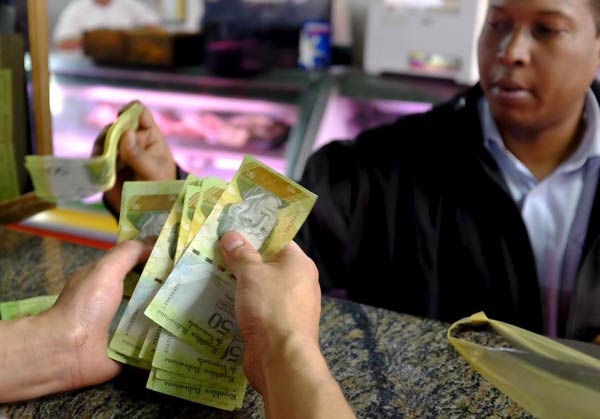
A cashier counts bolivar notes at a butchery in a public market in Caracas, Venezuela January 22, 2016. [Photo/Agencies] |
With Venezuela facing a deep economic crisis and political stalemate, Beijing's loans to Caracas have become a heated topic of discussion at home and abroad, especially after the Western media reported that China recently sent an "unofficial envoy" to meet with Venezuela's opposition party. Such reports are not confirmed by Chinese Foreign Ministry.
Some Western media outlets interpreted this as China's attempt to curry favor with Venezuela's opposition to ensure its loans to the country are recognized even if President Nicolas Maduro steps down. This perception is wrong.
Since China adheres to the principle of non-interference in other countries' internal affairs, it will continue its mutually beneficial cooperation with Venezuela on the basis of the Five Principles of Peaceful Coexistence no matter which political party is in power. Also, there is no reason for a Venezuela ruled by a certain political party not to deal with foreign creditors, especially China, its largest foreign creditor.
The debt problem Venezuela faces is a result of its liquidity crisis, not solvency crisis. This means the huge loans China has given to Venezuela, contrary to what some claim, are retrievable. Besides, Venezuela's abundant resources and China's comprehensive national strength are enough to ensure the long-term safety of these loans.
Indeed, Venezuela now lacks the capability to repay foreign loans. By the end of September 2015, its foreign debt had reached $148.83 billion, of which $65 billion were loans it had taken from China since 2005. Compounding the problem is the fact that Venezuela has only $15.6 billion in foreign exchange reserves.
But Venezuela has an explored oil reserve of 297.7 billion barrels, the largest in the world. It also has a colossal confirmed reserves of natural gas, iron ore, coal, bauxite, limestone, nickel, gold, diamond and uranium. It is also rich in hydro-power and forest resources, with its forest coverage rate being 56 percent. Such abundant natural resources mean Venezuela is more than capable of repaying its foreign debts despite the continuation of the liquidity crisis.
As one of the world's leading oil importers, China's loans can indeed help Venezuela maintain normal oil production and prevent oil prices from increasing. With a daily oil output of 2.9 million barrels and export of 2.33 million barrels, any indication of Venezuela suspending production will send oil prices soaring.
But believing its credit assets in Venezuela are safe in the long term does not mean China should not make some proactive arrangements. To begin with, China should help the Venezuelan government to get the approval of its opposition-dominated parliament for its debt restructuring, in order to gain political guarantee for the safety of its assets in the country. And since the Venezuelan government, not its ruling United Socialist Party, took the loans from China, the succeeding government will be obliged to repay them.
But China has to specify that some of its loans to Venezuela are meant for the latter to maintain oil and gas production and exports, and promote the formulation of some corresponding management methods. Under pressure to repay the principal and interest amounts for its imports and matured debts, Venezuela has used a very small part of its oil export revenue to maintain oil production and transport facilities. So, to ensure Venezuela's largest source of fiscal revenue is not interrupted and prevent a lose-lose scenario for both creditor and debtor, it is necessary for China to specify that some of its loans are meant for Venezuela's oil production and export.
With the deepening of its economic and social crisis, Venezuela is likely to grant foreign capital, including Chinese capital, access its oil and gas production and transport to help create favorable conditions for possible debt-to-equity deals with China, its largest creditor.
The author is a researcher at the International Trade and Economic Cooperation Institute of the Ministry of Commerce.



Copyright 1995 - . All rights reserved. The content (including but not limited to text, photo, multimedia information, etc) published in this site belongs to China Daily Information Co (CDIC). Without written authorization from CDIC, such content shall not be republished or used in any form. Note: Browsers with 1024*768 or higher resolution are suggested for this site.
License for publishing multimedia online 0108263 Registration Number: 130349