 |
|
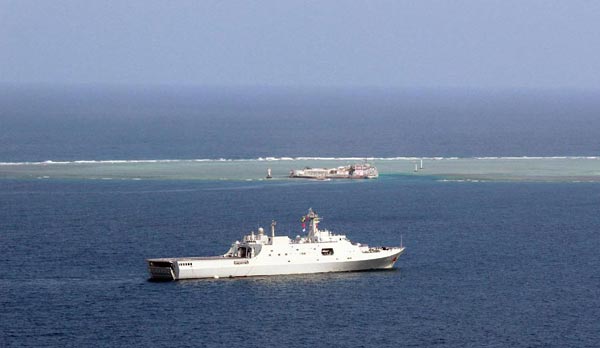
A formation of the Nanhai Fleet of China's Navy on Saturday finished a three-day patrol of the Nansha islands in the South China Sea. [Photo/Xinhua] |
The Philippines is resuming work on upgrading a military airport on an island it seized from China, a move that again displays its expansionist nature and belies its self-assumed image as a victim in the territorial disputes in the South China Sea.
It is also a slap in the face for certain countries that always accuse Beijing of taking provocative steps while turning a blind eye to Manila's provocative moves.
The Nansha Islands in the South China Sea have been Chinese territory since ancient times, as proved by historical and international documents.
However, the Philippines started to use military force to seize the Nansha Islands, one by one, in the 1970s. So far eight Chinese islands, including Zhongye Island-where it intends to upgrade its military airport-are in the Philippines' hands.
Over the years, Manila has tightened its grip on the Chinese islands it has illegally occupied, by relocating civilians there, building military facilities, such as airports and docks, and most recently, installing a flight-tracking system on Zhongye.
It is such unilateral actions that have sparked and fueled the tensions in the South China Sea.
The Philippines has even been brazen enough to stage the farce of a villain suing his victim by seeking arbitration of its territorial disputes with China at the international tribunal in The Hague, which China, as is its right, does not accept.
The move is a political provocation under the cloak of international law, and Manila would not have staged such a stunt without the connivance and encouragement of its ally, the United States, which is more than happy to use the Philippines as a pawn to contain a rising China.
The US and some of its allies, although not directly involved in the South China Sea disputes, have singled out China as a threat to regional peace and stability. They have pointed accusing fingers at the country for its countermeasures to safeguard its sovereignty, and its construction of facilities on its islands for navigation and meteorological observation purposes.
Such partiality runs counter to the pledge not to take sides in territorial disputes in the region, and emboldens the Philippines and other parties to go further in challenging China's sovereignty.
China has always opposed the Philippines for its illegal occupation of its islands, and any construction projects on them will not consolidate Manila's illegal claim to sovereignty. Instead, they will strengthen Beijing's resolve to protect its maritime territory from further encroachment.


I’ve lived in China for quite a considerable time including my graduate school years, travelled and worked in a few cities and still choose my destination taking into consideration the density of smog or PM2.5 particulate matter in the region.

Copyright 1995 - . All rights reserved. The content (including but not limited to text, photo, multimedia information, etc) published in this site belongs to China Daily Information Co (CDIC). Without written authorization from CDIC, such content shall not be republished or used in any form. Note: Browsers with 1024*768 or higher resolution are suggested for this site.
License for publishing multimedia online 0108263 Registration Number: 130349