 |
|
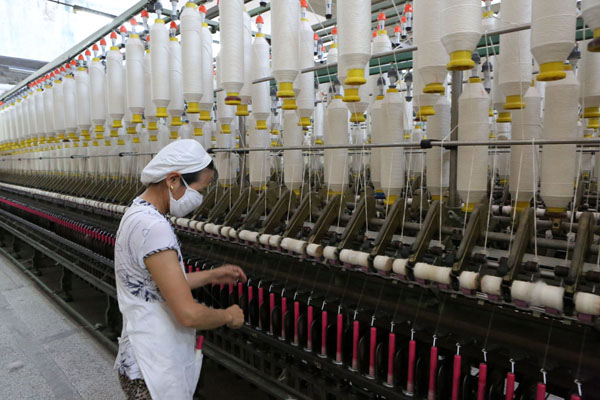
An employee works at a State-owned textile plant in Huai'an, Jiangsu province. The reform of China's State-owned enterprises and getting rid of so-called zombie corporations is a central plank of the supply-side economic program. [Photos provided to china daily] |
China is reportedly considering a plan for debt-to-equity swaps, which are designed to bail out debt-ridden firms amid the economic downturn and prevent the non-performing loans of banks from rapidly piling up.
It is a stopgap measure, but one that, if it works well, will improve the operational efficiency of both enterprises and banks. However, detailed, applicable implementation policies must be put in place to ensure the program does not go awry.
Policymakers must have been encouraged by the previous equity-for-debt program, initiated at the end of the 1990s, in which many insolvent State-owned enterprises were saved from going bankrupt.
Indeed, in the best-case scenario, such a scheme will have a number of potential benefits. Companies can have their debt burdens reduced and improve their balance sheets so they can borrow more from banks, making it possible for them to step out of difficulties when the macroeconomic situation improves.
For the banks, their loan books will look better. As their non-performing loan ratio is kept from rising, they would also become willing to extend new loans to the corporate sector, which is crucial considering China's fragile economic fundamentals.
For the financial markets, the rising bad loans of banks would deal a heavy blow to investors, leading to market turbulences.
And for the government, such a program can prevent mass bankruptcies and lay-offs-which affect social stability-from occurring.
Admittedly, the non-performing loan ratio of Chinese banks is quite low compared with late 1990s, when it was more than 30 percent. By the end of 2015, the ratio had dropped to 1.67 percent.
But the ratio has been rising quickly in recent years, and if the trend continues, it could jump to higher levels since many enterprises may go bankrupt as China continues to push for reducing the over-capacity in some sectors. Policymakers, therefore, have understandably taken a preemptive measure to prevent the situation from worsening.
The debt-to-equity swap may not be the fundamental and best solution to China's current economic and corporate woes, but in a big transitional economy such as China's, is there ever a best option to all the problems, one that will not produce any side effects or make new troubles?
In the last round of equity-for-debt swaps, many enterprises that had been trapped in debt witnessed improved performance; some have even grown into industry heavyweights with global business links.
What policymakers should do is to devise a thorough policy framework to deal with the potential problem of enterprises taking on more risks because others now bear the cost of those risks.
Looking back, there have been some lessons that can be learnt by policymakers in charge of the upcoming program.
Above all, feasible policies should be devised to prevent the moral hazard from occurring.
The program will involve multiple players, including enterprises, banks, intermediaries, bad asset management companies, and local government agencies. They have different interest considerations and will try to maximize their interest in the process of the swap. For example, some enterprises may take advantage of the program to avoid repaying their debts; some local governments may try to include enterprises that technically should go bankrupt in the program to avoid mass lay-offs, which will bring more defaulting risks to the banks in the future.
Therefore, there must be clear and applicable technical standards to govern what types of enterprises should be included into the program, a task that depends on market-oriented assessment work by independent intermediaries.
China, unfortunately, lacks such intermediary companies and this poses a challenge to policymakers.
The author is a senior writer with China Daily. xinzhiming@chinadaily.com.cn


Colombian coffee has a story that I admire and use in my lectures and the reasons are the ones listed above. Congratulations!


Copyright 1995 - . All rights reserved. The content (including but not limited to text, photo, multimedia information, etc) published in this site belongs to China Daily Information Co (CDIC). Without written authorization from CDIC, such content shall not be republished or used in any form. Note: Browsers with 1024*768 or higher resolution are suggested for this site.
License for publishing multimedia online 0108263 Registration Number: 130349