 |
|
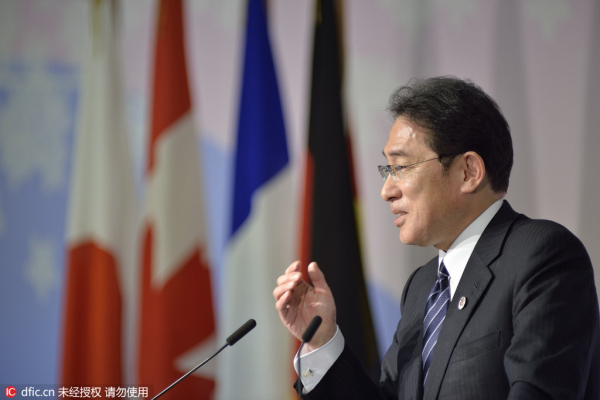
Japanese Foreign Minister Fumio Kishida gestures during a press conference at the International Media Center in Hiroshima, Japan on April 11, 2016 after Foreign Ministers meeting of G7 countries visit the Peace Memorial Museum. [Photo/IC] |
Although it does not mention China by name, a statement issued after the G7 foreign ministers' meeting in Hiroshima on Monday about the disputes in the South China Sea can be interpreted as veiled criticism of China for being the cause of the increased tensions in the region.
This is false and unfair.
China has pursued peaceful settlement of the South China Sea disputes directly with the countries concerned according to international law and on the basis of respecting historical facts. And it has sought to maintain peace and stability in the waters through talks and consultations, as advocated in the Declaration on the Conduct of Parties in the South China Sea.
The G7 statement has ignored these efforts and fails to acknowledge the restraint China has exercised while seeking ways to peacefully resolve the disputes-despite China being the biggest victim, with many of its reefs and islands illegally occupied by other countries.
By turning a blind eye to facts, the G7 statement only complicates the situations in the South China Sea and further fuels tensions.
It also signals the G7 members risk becoming tools of Japan for its own ulterior and selfish interests.
As the statement was as Japan sought, it corroborated earlier speculation that Japan would make good use of being the host of the meeting to advance its own interests and purpose.
Japan can claim to have scored some diplomatic points for exaggerating the "China threat" to the international community as part of its public opinion war. And it has succeeded in driving a wedge between China and some other G7 members by acting like a thief yelling "catch the thief".
The tension in the South China Sea has long been fanned by some countries not directly involved in the territorial disputes, and Japan has played an inglorious role in this with its increased military presence in the region.
Japan sent a submarine and warships to the Philippines as that country was preparing for joint military drills with the US recently. And Japanese Prime Minister Shinzo Abe has pushed through new security laws and is seeking to amend the Constitution to pave the way for Japan's military resurgence under the guise of becoming a "normal state".
It is this, as well as other important issues such as global economic recovery, that should be the real concern of the other G7 members.
Instead, the G7 statement once again underlines a lack of statesmanship and foresight in the group's policymaking, factors that will prevent it from wielding wider influence in international affairs.


I’ve lived in China for quite a considerable time including my graduate school years, travelled and worked in a few cities and still choose my destination taking into consideration the density of smog or PM2.5 particulate matter in the region.

Copyright 1995 - . All rights reserved. The content (including but not limited to text, photo, multimedia information, etc) published in this site belongs to China Daily Information Co (CDIC). Without written authorization from CDIC, such content shall not be republished or used in any form. Note: Browsers with 1024*768 or higher resolution are suggested for this site.
License for publishing multimedia online 0108263 Registration Number: 130349