 |
|
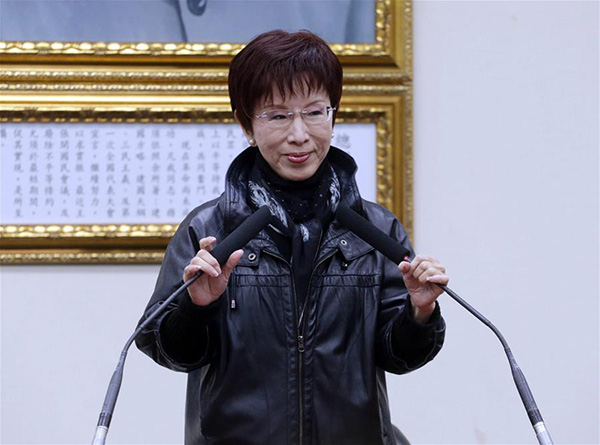
Hung Hsiu-chu attends a press conference in Taipei, March 26, 2016. [Photo/Xinhua] |
The outgoing Kuomintang party is not unfamiliar with losing power in Taiwan. With Tsai Ing-wen of the Democratic Progressive Party taking office as the island's leader on May 20, the KMT will become an opposition party for the second time since 2000.
But history does not repeat itself.
Compared with its setback 16 years ago, the 122-year-old party and its chairwoman Hung Hsiu-chu, who was elected as the party's first female leader on Saturday, face even more daunting challenges and a tougher mission ahead.
Still recovering from its crushing defeat in the island's elections, the embattled party needs to first rally and revive itself.
It needs to heal its self-inflicted wounds, by eradicating its inner rivalries and closing ranks within the party.
It needs to reform the party institution, improve its decision-making, adjust policies and refresh its image to regain the support of young voters, who have increasingly favored the DPP.
But with cross-Straits ties facing uncertainties, given the pro-independence DPP's control over both the island's legislature and administration, a much bigger test for the KMT, will be whether it can play the necessary role of stabilizer while in opposition.
Tsai and her party's refusal to approve the 1992 Consensus on one China, the foundation for the improving ties between the island and the mainland, might again trigger cross-Straits confrontation as experienced from 2000 to 2008 when the DPP under the leadership of Chen Shui-bian was in power on the island.
At that time it was the KMT's promotion of closer economic and cultural exchanges with the mainland that helped offset the fallout from Chen's secessionist push for Taiwan "independence" and kept a rein on cross-Straits tensions.
The cross-Straits rapprochement engineered by the previous leader of the KMT Ma Ying-jeou has benefited the island. So there is no reason for the KMT to abandon its pursuit of stronger cross-Straits ties while opposing any pro-independence moves.
Instead it should continue to shoulder the responsibility of promoting ties and make greater efforts to help maintain stable and peaceful relations with the mainland while the DPP is in power.
Although Tsai herself has not adopted Chen's provocative policy and said she backs the status quo, radicals in the DPP seeking "independence" might damage cross-Straits ties if not kept in check.
The KMT can restrain the ruling DPP from going too far in endangering cross-Straits peace, which is in the interests of both sides.

I’ve lived in China for quite a considerable time including my graduate school years, travelled and worked in a few cities and still choose my destination taking into consideration the density of smog or PM2.5 particulate matter in the region.

Copyright 1995 - . All rights reserved. The content (including but not limited to text, photo, multimedia information, etc) published in this site belongs to China Daily Information Co (CDIC). Without written authorization from CDIC, such content shall not be republished or used in any form. Note: Browsers with 1024*768 or higher resolution are suggested for this site.
License for publishing multimedia online 0108263 Registration Number: 130349