 |
|
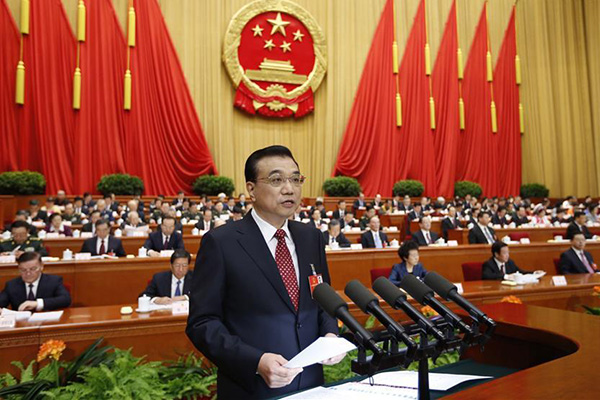
Chinese Premier Li Keqiang delivers a government work report during the opening meeting of the fourth session of the 12th National People's Congress at the Great Hall of the People in Beijing, capital of China, March 5, 2016. [Photo/Xinhua] |
China must avoid falling into the middle-income trap, Premier Li Keqiang cautioned when delivering this year's Government Work Report to the National People's Congress in Beijing earlier this month. Beijing Youth Daily said on Wednesday:
The so-called middle-income trap has haunted some Asian and Latin American economies, which after managing to get rid of poverty, have failed to complete the necessary economic transition to realize the next stage of development. This has resulted in economic stagnation, widening income gaps, severe corruption, high unemployment and financial fragility.
Premiere Li's warning is timely as China's GDP per capita reached $8,000 last year, which is just over the middle income level. More importantly, its remarkable economic rise in the past three decades or so has been fueled by high investments and the consumption of natural resources, as well as labor-intensive and export-oriented development, which is not sustainable.
However, to say China will inevitably get caught in the middle income trap is going too far, because China still has time to avoid it by changing to a growth mode driven by technology and productivity.
Regarding its deepening comprehensive reform and efforts to promote technical innovations, the country has already approved a universal second-child policy to meet the foreseeable demand for labor. It should now put more effort into expediting the ongoing reform of the household registration system and farmland ownership, as well as enhancing vocational education, to help more migrant workers settle in cities and rural residents improve their livelihoods.
For the time being, China's educational expenditure has only accounted for about 4 percent of its total GDP, nearly 1.5 percent less than that of the United States and even 3 percent less than Finland's. It has been proved that higher education can partly offset the dwindling population dividends. Of course, rural residents and their children have to be treated equally if they permanently live in a city.
Technological innovations, too, should play a bigger role in the country's long-term growth. Apart from doubling the financial support for scientific research, more measures need to be taken to curb the violations of intellectual property rights.

I’ve lived in China for quite a considerable time including my graduate school years, travelled and worked in a few cities and still choose my destination taking into consideration the density of smog or PM2.5 particulate matter in the region.

Copyright 1995 - . All rights reserved. The content (including but not limited to text, photo, multimedia information, etc) published in this site belongs to China Daily Information Co (CDIC). Without written authorization from CDIC, such content shall not be republished or used in any form. Note: Browsers with 1024*768 or higher resolution are suggested for this site.
License for publishing multimedia online 0108263 Registration Number: 130349