 |
|
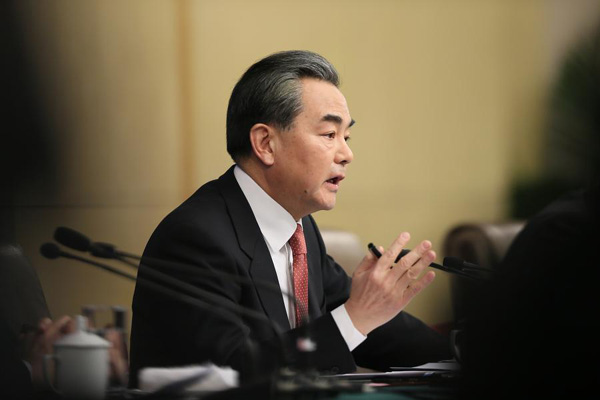
Chinese Foreign Minister Wang Yi takes questions from the press during a news conference on the sidelines of the two sessions on Tuesday. [Photo/Xinhua] |
Beijing's quarrels with Tokyo and Washington, whether about territorial disputes or so-called freedom of navigation, are essentially about international law.
But increasingly they are drifting away from the truth, causation of the matter, and international law. Increasingly they seem to be stuck in an endless loop of meaningless finger-pointing.
If they are to break free of that loop, Chinese Foreign Minister Wang Yi made some valid points on Tuesday that are worth deliberation.
At a news conference on the sidelines of the National People's Congress, Wang reminded us of a less-mentioned, yet very important, aspect of the diplomatic bickering.
Talking about the frictions between China and the United States, Wang said: "The source of these frictions is that there have always been some people in the US who cherish strategic suspicions about China, they are worried that China will one day supersede the US."
Reiterating that China has "no intention to displace anybody or dominate anybody", he suggested Washington try to appreciate China's history and traditions, and refrain from the impulse of "judging China with an American mindset".
His diagnosis and prescription for the troubled China-Japan relations were similar. "The root cause is something has gone wrong in Japanese leaders' understanding of China," he pointed out, suggesting that they ask themselves whether they want China to be a friend or enemy, partner or rival.
Problematic mutual perceptions are actually the most troubling factor in present-day China-Japan, China-US relations.
It was crucial for Wang to clarify that China has never, will never raise new territorial claims in the South China Sea. And that Beijing's refusal to accept the Philippines-proposed international arbitration is entirely in accordance with the United Nations Convention on the Law of the Sea, while the Philippine practice is "unlawful, unfaithful and unreasonable".
Beijing also has its own homework to do in both crisis control and dispute resolution. Its past failure to articulate such revealing truths is partly to blame for outsiders' misperceptions about China's behavior and strategic purposes, and left room for manipulation by parties with malicious intentions.
Tokyo and Washington's misinterpretation of Beijing's intentions does involve ignorance and misunderstanding, but to a greater extent it is due to their over-interpretation of and over-reaction to Beijing's strategic purposes.
It will not be easy for Beijing to talk Tokyo and Washington into believing it is committed to becoming a different type of major power, as evident from Washington's lukewarm response to its proposal of a new type of major-country relationship.
But that is no excuse to give up. Instead, besides acting differently from previous world powers, Beijing should redouble its efforts to explain itself and communicate its intentions.
Copyright 1995 - . All rights reserved. The content (including but not limited to text, photo, multimedia information, etc) published in this site belongs to China Daily Information Co (CDIC). Without written authorization from CDIC, such content shall not be republished or used in any form. Note: Browsers with 1024*768 or higher resolution are suggested for this site.
License for publishing multimedia online 0108263 Registration Number: 130349