 |
|
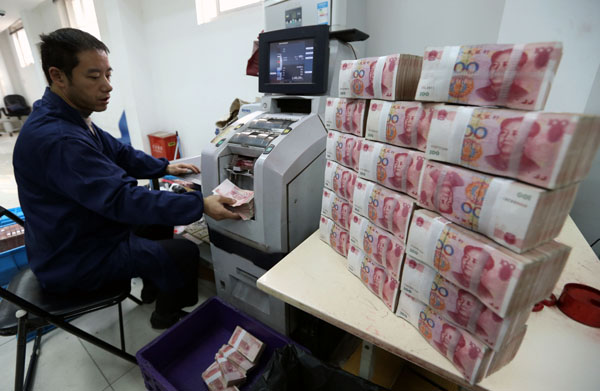
A bank employee prepares bank notes at an Industrial and Commercial Bank of China Ltd cash center in Wuxi, Jiangsu province. [Photo provided to China Daily] |
In early February, as China celebrated the start of the Year of the Monkey, a widely circulated hedge fund newsletter roiled financial markets by predicting a hard landing for the economy, the collapse of the "shadow-banking" system and the devaluation of the yuan. Stability returned only after People's Bank of China Governor Zhou Xiaochuan, in an interview with Caixin magazine, explained the logic of China's exchange-rate policy.
But China's ability to maintain that stability depends on a multitude of interrelated factors, such as low productivity growth, declining real interest rates, disruptive technologies, excess capacity and debt overhangs, and excess savings. In fact, the current battle over the yuan's exchange rate reflects a tension between the interests of the "financial engineers" (such as the managers of dollar-based hedge funds) and the "real engineers" (Chinese policymakers).
Foreign exchange markets are, in theory, zero-sum games: the buyer's loss is the seller's gain, and vice-versa. Financial engineers love speculating on these markets, because transaction costs are very low and leveraged naked shorts are allowed, without the need to hedge an underlying asset. The exchange rate, however, is an asset price that has huge economic spillovers, because it affects real trade and flow of direct investment.
Financial engineers are increasingly shaping the exchange rate through financial transactions that may not be linked to economic fundamentals. Because financial markets notoriously overshoot, if the short sellers win by pushing exchange rates and the real economy into a low-level equilibrium, the losses take the form of investment, jobs and income. In other words, financial engineers' gain is real people's pain.
In order to achieve these gains, financial engineers use the media to influence market behavior. For example, short sellers portray sharp declines in commodity and oil prices as negative factors, even though lower energy prices actually benefit most consumers-and even some producers, by allowing them to compete with their oligopolistic counterparts. It is estimated that lower oil and commodity prices could add some $460 billion to China's trade balance, largely offsetting the loss in foreign exchange reserves in 2015.
Similarly, China's growth slowdown and the rise of non-performing loans are being discussed as exclusively negative developments. But they are also necessary pains on the path to supply-side reform aimed at eliminating excess capacity, improving resource efficiency and jettisoning polluting industries.
The real engineers, excluding those whose judgment is clouded by personal financial interests, should counter this influence, while refusing to succumb to the temptation of quick fixes. Fortunately, China's authorities have long understood that a stable yuan exchange rate is critical to national, regional and global stability. Indeed, that is why they did not devalue the yuan during the Asian financial crisis. They saw what most analysts missed: leaving the US dollar as the main safe-haven currency for global savings, with near-zero interest rates, would have the same deflationary impact that the gold standard had in the 1930s.



I’ve lived in China for quite a considerable time including my graduate school years, travelled and worked in a few cities and still choose my destination taking into consideration the density of smog or PM2.5 particulate matter in the region.
Copyright 1995 - . All rights reserved. The content (including but not limited to text, photo, multimedia information, etc) published in this site belongs to China Daily Information Co (CDIC). Without written authorization from CDIC, such content shall not be republished or used in any form. Note: Browsers with 1024*768 or higher resolution are suggested for this site.
License for publishing multimedia online 0108263 Registration Number: 130349