 |
|
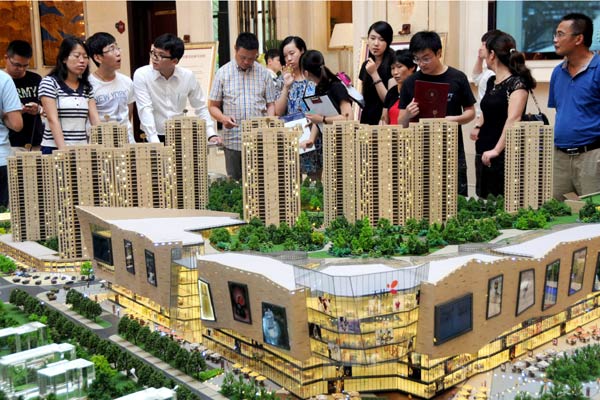
Potential homebuyers examine a property project model in Hangzhou, capital of Zhejiang province, Aug 31, 2014. [Photo/Xinhua] |
CHINA'S FIRST-TIER CITIES, Beijing, Guangzhou, Shanghai and Shenzhen, have witnessed a steady drop in housing inventory, after the central government issued a series of policies aimed at clearing a property glut in the country. Third- and fourth-tier cities, however, still have a long way to go in destocking their inventories. Governments at all levels are supposed to tailor their real estate policies based on local market conditions, said People's Daily on Tuesday.
Government efforts to clear the supply glut in China's property market seem to be working, at least in the first-tier cities. Over 6,000 second-hand housing transactions were completed in Beijing during the first week after Spring Festival (Feb 14 to 20), the most since 2010.
The ongoing recovery in the housing markets in first-tier cities, however, has prompted some real estate developers to look to second-tier cities, where "the flour has become more expensive than the bread" for the first time. A land plot at a recent auction in Foshan, South China's Guangdong province, came close to outstripping developed property prices in the neighborhood.
That being said, it would be inappropriate to understate the extent of country's property glut, which varies from city to city. Less developed third- and fourth-tier cities, for example, still need more time to finish destocking their local housing inventories.
As clearing the nationwide property glut has become a priority for all property developers, many local governments have issued relevant guidelines and plans to ensure healthy development of real estate market, while offering financial subsidies and loosening restrictions on house purchasing.
More of them are expected to do so this year, and household registration reform is also in the making, which will boost the demand from new residents. The National Development and Reform Commission, China's top economic planning body, has said it is working on reducing constraints on migration and urban registration to fuel demand and accelerate the country's urbanization.
Should the plan come into effect, about 100 million rural residents will be able to acquire an urban household registration and live in cities. This will stimulate the property market in the longer run.
Of course, given their different real estate situations, major cities, which are unlikely to cancel their house-purchasing restrictions, should focus on keeping a rein on speculation. Third- and fourth-tier cities should put more efforts into destocking their inventories.
Apart from enhancing the implementation of real estate policies issued last year, local authorities could offer tax deductions on mortgage interest, expedite the construction of low-income housing with the help of market, and introduce real estate investment trusts to boost the domestic property market.
Copyright 1995 - . All rights reserved. The content (including but not limited to text, photo, multimedia information, etc) published in this site belongs to China Daily Information Co (CDIC). Without written authorization from CDIC, such content shall not be republished or used in any form. Note: Browsers with 1024*768 or higher resolution are suggested for this site.
License for publishing multimedia online 0108263 Registration Number: 130349