 |
|
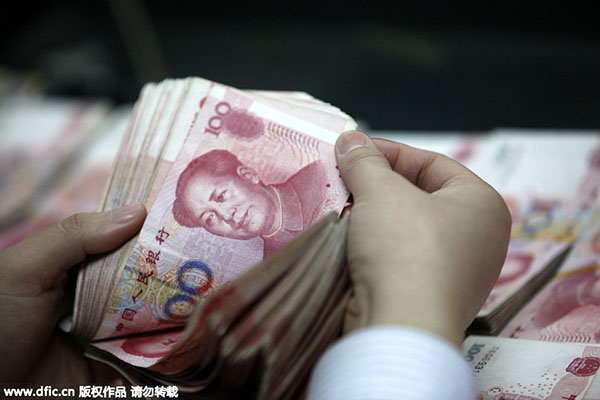
A Chinese clerk counts RMB (renminbi) yuan banknotes at a bank in Huaibei city, East China's Anhui province, January 22, 2015. [Photo/IC] |
China has taken major strides in terms of social security and protection. Policies have been built on a combination of social insurance, social assistance and welfare services. And of major importance is the nine-year free and compulsory education for all. Increasingly larger percentages of the population, including the most vulnerable groups, such as poor rural residents, the unemployed and-to a gradually larger extent-migrant workers, have been included in social policies. Minimum living standards schemes, as well as medical insurance and pension schemes have been introduced, although with a fragmented structure and variations in organization, scope of implementation, entitlements and benefit generosity based on people's hukou (household registration) status and other criteria. Therefore, benefits are for many very modest.
The welfare system is not uniform across the country, but there is at least a declared political aim of achieving universal coverage by 2020. Access to and standards of education and health have been greatly improved, although rural-urban and regional inequalities persist, as does the inequality of income distribution. Compared with developed (some would say "over-developed") European "welfare states", there are also some elements missing in the Chinese social policy development, such as family policy to facilitate reconciliation of childcare and work, and promotion of gender equality.
This policy area, in combination with the recent lifting of the one-child policy, can be crucial for achieving the politically desired increase of the fertility rate to a level that would help maintain a more balanced age composition of the population.
China's economic development makes room for expansion of social policy, but the development of social policy cannot be considered to have been a driver for economic development, as it has in other East Asian countries, and also historically in parts of Europe. For example, one of many motivations for Germany's first chancellor Otto von Bismarck to introduce the world's first large-scale social insurance program in the 1880s was to make Germany perform better in international economic competitions.



I’ve lived in China for quite a considerable time including my graduate school years, travelled and worked in a few cities and still choose my destination taking into consideration the density of smog or PM2.5 particulate matter in the region.
Copyright 1995 - . All rights reserved. The content (including but not limited to text, photo, multimedia information, etc) published in this site belongs to China Daily Information Co (CDIC). Without written authorization from CDIC, such content shall not be republished or used in any form. Note: Browsers with 1024*768 or higher resolution are suggested for this site.
License for publishing multimedia online 0108263 Registration Number: 130349