China leads way in dealing with a scourge England is beginning to grapple with
Plastic bags. Hard to believe, but 40 years ago they were something of a novelty.
But in recent years, as shops and supermarkets got into the habit of handing them out at the drop of a hat for even the smallest of purchases, they have become a major pollutant and a threat to wildlife.
The World Wide Fund for Nature estimates that an average of more than 100,000 whales, seals and turtles die every year from either ingesting plastic bags or being ensnared by them. In India, something like 20 cows a day die from eating plastic bags.
In China, the local and global effects of discarded plastic bags is known as "white pollution".

But now, from China to the United Kingdom, countries are slowly taking action to rid the world of the plague of plastic bags, many of which take years to decompose, if at all.
The Pacific Ocean is home to a vast floating mass of discarded plastic packaging, including bags, the size of France, and weighing 3 million tons. Plastic bags, when not choking wildlife, can take up to 100 years to degrade.
So let's take China.
Because of its sheer size and population, statistics out of China tend to be breathtaking.
Bedevilled by blocked sewage systems and general plastic bag waste, the Beijing authorities decided drastic action was needed.
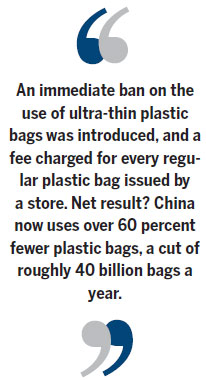
An immediate ban on the use of ultra-thin plastic bags was introduced, and a fee charged for every regular plastic bag issued by a store. Net result? China now uses over 60 percent fewer plastic bags, a cut of roughly 40 billion bags a year.
Reviewing the government's action, the National Development and Reform Commission put the reduction in plastic bag use at 66 percent. Before the ban, China used at estimated 37 billion barrels of crude oil annually to produce plastic packaging.
Put another way, the average saloon car could drive for about 11 meters on the amount of petrol needed to make one single plastic bag. You do the math, as our American cousins say.
Policing such policies isn't easy, and China has tackled that issue by assigning a 600,000 strong force of inspectors, who regularly monitor 250,000 retail stores and markets countrywide, generating about 2 million renminbi ($315,000; 287,000 euros) in fines.
Fines announced by the State Administration of Industry and Commerce of as much as 10,000 renminbi have had the effect of concentrating the mind wonderfully.
Still, the effect has been inconsistent. A survey by Global Village, a Beijing-based environmental group, found 80 percent of rural stores were still issuing bags free of charge.
On top of that, 96 percent of food markets in Beijing continued to use plastic bags, covered by an exemption in the law that allows plastic packaging for raw meat and noodles on hygiene and safety grounds.
How are we doing in the UK?
The answer, I fear, is not as well.
A charge of 5 pence (8 cents; 7 euro cents) per plastic bag was introduced only at the beginning of last month, although Scotland had introduced a similar charge last year, which saw the number of plastic bags handed out by stores slashed by 80 percent, the equivalent of 650 million bags, in a year, and 6.7 million pounds raised from the charge for charities.
Wales was a pioneer in the UK in introducing a bag charge in 2011, and Northern Ireland followed suit in 2013.
How has it gone down in England?
Well, the British media, always looking for the negative, immediately reported a huge surge in the theft of supermarket trolleys and wire baskets, but I find that like other members in my family, I have got into the habit of carrying spare shopping bags in the car and refusing a bag when buying one or two items.
Maybe, just maybe, that will start to make a dent in the average of 140 plastic bags held in a UK household.
The author is managing editor of China Daily Europe, based in London. Contact the writer at chris@mail.chinadailyuk.com


Copyright 1995 - . All rights reserved. The content (including but not limited to text, photo, multimedia information, etc) published in this site belongs to China Daily Information Co (CDIC). Without written authorization from CDIC, such content shall not be republished or used in any form. Note: Browsers with 1024*768 or higher resolution are suggested for this site.
License for publishing multimedia online 0108263 Registration Number: 130349