 |
|
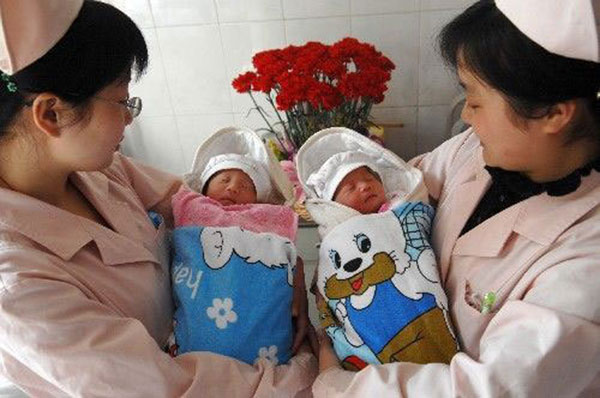
Two nurses hold baby boy and girl twins at a hospital in Hefei, Central China’s Anhui province. [Photo/Xinhua] |
The communiqué issued after the recently concluded Fifth Plenum of the 18th Communist Party of China Central Committee said all couples will be allowed to have two children, ending the one-child policy for the overwhelming majority of the population.
The 12th Five-Year Plan (2011-2015) period was the first to see a real change in the strict family planning policy that was implemented in the late 1970s to check the booming population. In 2013, the government announced that couples could have a second child if either husband or wife was the only child of his/her parents.
But most eligible couples seemed disinterested in having a second child. This shows there is no fear of a rebound in the fertility rate; instead, China should worry about its low fertility rate and shrinking population.
The fifth national census in 2000 showed China's total fertility rate was 1.22, lower than the low fertility rate threshold of 1.3. The number further declined to 1.18 in the sixth census in 2010, and has hovered around 1.3 in recent years, which means China has already fallen into the "low fertility trap".
Studies show that since the launching of reform and opening-up, the desire of childbearing-age women to have the ideal number of children has been very low, about 1.6 to 1.8. And the strict family planning policy lowered their desire further, pushing the fertility rate much lower.
Another worrying trend is the declining fertility level from generation to generation: the fertility level of women born in the 1980s is lower than that of the post-1970 generation, while that of the post-1990 generation is even lower.
Many families consider the cost of raising children, the pressure of supporting aged parents and the decline in their own living conditions before deciding to have a child. As such, the "low fertility culture" is the result of the new generation's voluntary decision to have only one child, or no child at all despite husband and wife both holding jobs.



I’ve lived in China for quite a considerable time including my graduate school years, travelled and worked in a few cities and still choose my destination taking into consideration the density of smog or PM2.5 particulate matter in the region.
Copyright 1995 - . All rights reserved. The content (including but not limited to text, photo, multimedia information, etc) published in this site belongs to China Daily Information Co (CDIC). Without written authorization from CDIC, such content shall not be republished or used in any form. Note: Browsers with 1024*768 or higher resolution are suggested for this site.
License for publishing multimedia online 0108263 Registration Number: 130349