 |
|
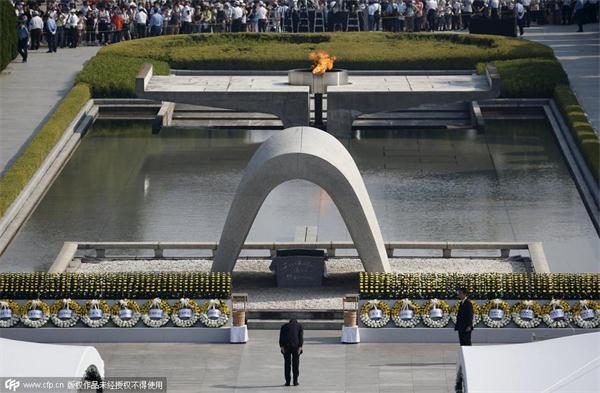
Japanese Prime Minister Shinzo Abe bows in front of the memorial cenotaph for victims of a 1945 atomic bombing during a memorial ceremony to mark the 70th anniversary at the Hiroshima Peace Memorial Park in western Japan on Aug 6, 2015.[Photo/CFP] |
On Aug 6 and 9, Japan observed the 70th anniversary of the atomic bombings of Hiroshima and Nagasaki that killed more than 200,000 people. The two atomic bombs dealt the final blow to imperial Japan, leading to its surrender to the Allied forces on Aug 15, 1945, and ending World War II.
The horrors of the atomic bombings made Japan adopt three principles against nuclear weapons. Delivering a speech in Hiroshima on Aug 6, Japanese Prime Minister Shinzo Abe, however, again failed to mention the three anti-nuclear principles - not possessing, not producing and not permitting nuclear weapons. His latest attempts to expand Japan's military role, especially his efforts to push two security bills through parliament, faced stiff criticism from atomic bomb survivors, and the mayors of Hiroshima and Nagasaki.
As the only country that has suffered atomic bomb attacks, Japan knows the devastating effects of nuclear weapons. But as a fascist power before and during WWII, Japan left a trail of death and destruction in the countries it invaded and/or occupied, including China and (then undivided) Korea.
WWII has taught us many lessons, but Abe does not seem to heed them. Wrongly assuming that admitting Japan's wartime atrocities will undermine young Japanese people's national pride, Abe refuses to apologize for the atrocities wartime Japan committed in Asian countries. Instead, he has decided to amend Japan's pacifist Constitution to enable the country's Self-Defense Forces to take part in military operations abroad, provide support to allies against attacks and perhaps to wage a war.
It may be true, as Japan's national public broadcaster NHK said on Monday, that Abe will include the words "apology" and "aggression" in his much speculated about statement on Aug 14 to mark the 70th anniversary of the end of WWII. But just a few days ago in Hiroshima and Nagasaki, he tried to take undue advantage of Japan being the only victim of atomic bombings, without saying why. In Nagasaki, however, he had to add the three anti-nuclear principles to his speech, because many people were angry that he had failed to mention them in Hiroshima three days earlier.
It is becoming increasingly clear that Japan is close to becoming a major regional military power "thanks to" the efforts of Japanese right-wingers. And it is feared Japan would reclaim the "right to collective self-defense" and start developing nuclear weapons should the upper house pass Abe's security bills.
Adopted in 1967, three anti-nuclear principles have served as a basic policy that all Japanese leaders are obliged to abide by. Yet they have never been fully applied, as US nuclear submarines and ships with nuclear arms have regularly visited Japanese harbors.
Apparently, by playing word games to exploit the loopholes in the Constitution and the anti-nuclear principles, the Abe administration is aiming to do something more than just whitewash Japan's shameful past: transforming Japan into a nuclear military power, to which peace-loving nations, first of all, the US, should pay more attention.
The author is a researcher in Japan studies at the Chinese Academy of Social Sciences.


Copyright 1995 - . All rights reserved. The content (including but not limited to text, photo, multimedia information, etc) published in this site belongs to China Daily Information Co (CDIC). Without written authorization from CDIC, such content shall not be republished or used in any form. Note: Browsers with 1024*768 or higher resolution are suggested for this site.
License for publishing multimedia online 0108263 Registration Number: 130349