 |
|
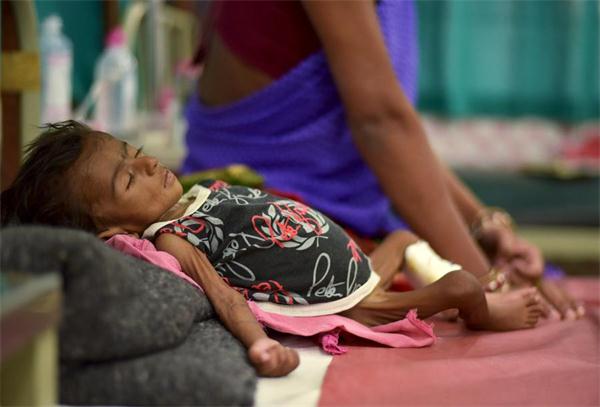
Two-month-old Jyoti lies in a bed in a malnutrition intensive care unit in Dharbhanga Medical College in Dharbhanga in the eastern state of Bihar, India, April 16, 2015. Despite India's economic boom over the last two decades, 46 percent of its children under five are underweight, 48 percent are stunted and 25 percent are wasted, according to the latest government figures. But what is not so widely known is that the majority are girls - abandoned, neglected or given less nutritious food than their male siblings, say health workers, attributing it to patriarchal attitudes in the country. Picture taken April 16, 2015. [Photo/Agencies] |
About 2.1 billion people, or almost 30 percent of the world's population, are regarded as overweight (defined as a body mass index, or BMI, of 25 or higher) - double the number in 1980, and more than 2.5 times the number of people who are chronically hungry. In fact, according to a recent report by the McKinsey Global Institute, being overweight or obese is now linked to 2.8 million deaths a year - more than those associated with being underweight - via non-communicable diseases like type-2 diabetes, cancer and cardiovascular diseases. This is a serious problem, and addressing it will require sustained and well-coordinated action.
The data are unambiguous. In the United Kingdom, for example, 37 percent of the population is now deemed overweight, with a quarter of that group qualifying as obese (a BMI of 30 or higher). Though being overweight or obese is often perceived as accompanying wealth, the problem has disproportionately affected lower-income communities.
Moreover, in recent decades, the scourge has been spreading rapidly in many developing countries, especially the more prosperous among them. In the emerging economies, the rate of increase in the number of overweight and obese children has been more than 30 percent higher than that of developed countries in recent years. In fact, the trend is accelerating everywhere, with the number of overweight people worldwide having increased by some 40 percent in the past decade alone. At this rate, half of the world's adult population will be overweight in about 15 years.
The economic burden that this imposes is massive. Accounting for diminished economic productivity, direct costs to healthcare systems and the investment required to mitigate the impact of obesity, the McKinsey report places the annual losses at $2 trillion, or 2.8 percent of world GDP. This grim situation has led the World Health Organization - and the UN more generally - to recognize obesity as an epidemic that must be addressed urgently.
As the McKinsey report notes, no single intervention will have a sufficient impact; a comprehensive strategy is needed. Based on an assessment of 74 potential measures, the report offers several recommendations. These include reducing fast-food portions, restricting food and beverage advertising, providing consumers (especially parents) with better nutrition information, reformulating processed foods, requiring more exercise at school, and ensuring balanced, varied and healthy meals at school and workplaces.
The key to progress will be strong political will. First and foremost, policymakers and the public must recognize the scale of the problem. Following the Second International Conference on Nutrition, organized by the UN Food and Agricultural Organization and the WHO in Rome last November, some worried that the extent of nutrition issues (including under-nutrition, micronutrient deficiencies and excessive weight), as well as their human and economic burden, were overestimated. But recent numbers suggest the opposite: the conference underestimated these figures - not least with regard to obesity.
Likewise, public and private investors should be made aware of the very high returns associated with tackling nutrition issues. As it stands, only about 1 percent of total aid is allocated for this purpose, as investors prefer to focus on projects that pay off quickly, rather than on those that require a longer-term commitment. If they understood the longer-term benefits of investment in tackling nutrition-related challenges, they might be willing to reconsider this approach.
With coordinated and concerted policy action, we can make great strides toward eliminating malnutrition in all its forms, including hunger, micronutrient deficiencies (or "hidden hunger") and the diet-related non-communicable diseases associated with obesity. With obesity rising fast, there is no time to waste.
The author, coordinator for Economic and Social Development at the Food and Agriculture Organization, received the 2007 Wassily Leontief Prize for Advancing the Frontiers of Economic Thought.
Project Syndicate



I’ve lived in China for quite a considerable time including my graduate school years, travelled and worked in a few cities and still choose my destination taking into consideration the density of smog or PM2.5 particulate matter in the region.
Copyright 1995 - . All rights reserved. The content (including but not limited to text, photo, multimedia information, etc) published in this site belongs to China Daily Information Co (CDIC). Without written authorization from CDIC, such content shall not be republished or used in any form. Note: Browsers with 1024*768 or higher resolution are suggested for this site.
License for publishing multimedia online 0108263 Registration Number: 130349