|
 |
|
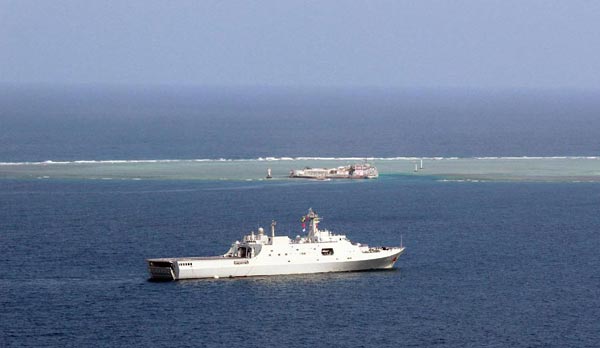
A formation of the Nanhai Fleet of China's Navy finished a three-day patrol of the Nansha islands in the South China Sea. [Photo/Xinhua]? |
Concerns over China-US relations’ future heightened last week after a US spy plane flew over some of China’s islands and reefs in the South China Sea. While the international community is anxious to know China’s response to the apparent US provocation, the fact is, Washington’s move has made Beijing’s case for reclamation and construction work in the South China Sea much stronger.
The US spy plane flew very close to the islands and reefs, including the Yongshu Reef of China’s Nansha Islands, on a reconnaissance mission on May 20, prompting Chinese forces to drive it off with warnings over the radio in accordance with regulations, Foreign Ministry Spokesman Hong Lei said.
China is carrying out reclamation and construction work in the waters which fall within its territory. Yet the US has been increasingly criticizing China saying its activities will raise tensions in the disputed waters and affect freedom of navigation in and flying over the seas.
With a CNN news crew on board the spy plane, the US intended to achieve three purposes: flex its muscles, exert pressure on China and show support for its allies in the Asia-Pacific region that have maritime territorial disputes with China. But since the US underestimated China’s resolve to defend its rights and interests, it is not surprising to see its calculations come to nothing.
The US has been implementing its “pivot to Asia” strategy to enhance its waning influence in the region and counterbalance the rise of regional powers — China and India. As the world’s sole superpower, the US is much more powerful than any country in the region and beyond. Therefore, the more it chooses to show off its force, the more people would interpret it as lack of confidence in its power projection in the future.
Sending a spy plane to China’s coast, a practice the US has been following for decades, could also reflect Washington’s toughening stance toward Beijing’s reclamation and construction work in the South China Sea. But Beijing sees neither reason nor legitimacy in Washington’s argument, because it is carrying out the reclamation and construction work in its territorial waters which will have no impact on freedom of navigation in and flying over the South Chin Sea.
Besides, the criticisms labeled by the US against China are based on favoritism and unfairness because the Philippines and Vietnam have built many facilities, including military ones, on China’s islands and islets in the South China Sea that they are illegally occupying. Surprisingly, the US has never seen their activities as troubling.
Under such circumstances, Beijing will neither yield to what it deems as Washington’s bullying tactics (flexing of muscles) nor wilt under the pressure of its unwarranted criticisms. On the contrary, it will continue with greater determination to carry out the reclamation and construction work. In short, China will remain undaunted to further provocations from the US.
As to the US support for its allies’ illegal territorial claims in the South China Sea, it could prove to be a double-edged sword; it could end up being counterproductive. For one thing, a military confrontation between the world’s largest and second-largest economies in the South China Sea can be good for neither side or, for that matter, any other country.
Last week’s incident has obviously raised tensions in the region and affected Sino-US ties. Many people in both countries tend to believe Washington and Beijing could clash over the South China Sea issue. But were such a clash to take place, it would serve neither party’s interests.
Washington obviously needs a serious rethink before it announces a major change in its policy and decides to openly contain the rise of China, because the price of doing so could be very costly.
The author is a senior writer with China Daily. wanghui@chinadacily.com.cn


Copyright 1995 - . All rights reserved. The content (including but not limited to text, photo, multimedia information, etc) published in this site belongs to China Daily Information Co (CDIC). Without written authorization from CDIC, such content shall not be republished or used in any form. Note: Browsers with 1024*768 or higher resolution are suggested for this site.
License for publishing multimedia online 0108263 Registration Number: 130349