 |
|
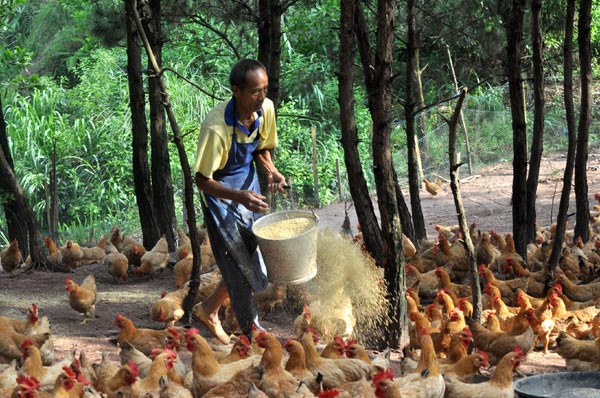
A farmer feeds his chickens in Dahua village of Rongxian county in the Guangxi Zhuang autonomous region on June 29. YU XIANGQUAN / FOR CHINA DAILY |
Many Chinese school students get low doses of antibiotics through their food and the environment. Recent news reports say 18 antibiotics were found in the urine samples of 58.3 percent of the 1,064 schoolchildren covered by a study in Shanghai, and Jiangsu and Zhejiang provinces. The results of the study on the children aged 8-11 years should prompt the health and environmental authorities to swing into action against the growing threat of antibiotics.
The presence of antibiotics in the students' urine can be attributed to the misuse and/or overuse of antibiotics in animal feed. And the growing use of antibiotics in animal feed is giving rise to superbugs, or microorganisms - mostly bacteria - that carry several antibiotic-resistance genes.
The seriousness of the problem is underscored by the World Health Organization, which in a recent report called this phenomenon a "global threat". The WHO report follows a 2013 US Centers for Disease Control and Prevention report, which showed that every year 2 million people in the US are infected with antibiotic-resistant bacteria, and 23,000 die from them. Last year, Dr Sally Davies, chief medical officer for England, called the problem a "ticking time bomb" and said that it probably will become as threatening in magnitude as climate change.
As a result of antibiotic resistance and the increasing number of superbugs, common infections that could be treated without major problems have become untreatable. In 2012, the WHO reported 450,000 cases of tuberculosis in 92 countries where multiple drugs used to treat them were found ineffective.
A similar situation could happen with gonorrhea, with very serious public health consequences. Sexually transmitted gonorrhea is now increasing across the world, and so is its resistance to antibiotic treatment.
Many bacteria acquire the ability to destroy antibiotics to protect themselves. They develop a gene for resistance to one or more antibiotics by mutation, which results in the production of enzymes that inactivate the antibiotics. Since bacteria accumulate resistance by developing new genes, in a strange twist of fate, genetics can work against us. Thus, any time a person uses an antibiotic without proper indication or for a shorter time than needed, it is promoting the development of antibiotic resistance.
Alexander Flemming, who discovered penicillin, warned against this danger in his 1945 Nobel Prize acceptance speech. He said: "The time may come when penicillin can be bought by anyone in the shops. Then there is the danger that the ignorant man may easily under-dose himself and by exposing his microbes to non-lethal quantities of the drug make them resistant."
In addition, the widespread use of antibiotics in animal feed to help them grow faster and put on more weight increases the magnitude of the problem. When livestock excrete the consumed antibiotics they are largely not broken down. These antibiotics then enter the environment through soil and water and, when ingested by humans, they retain the capacity to promote antibiotic resistance.
Thus, the resistant bacteria in animals because of the presence of antibiotics in their feed can be transmitted to humans in three ways: consumption of animal products, close contact with animals and through the environment.
With fewer drug options, the most negatively affected are the poor and those who lack health insurance because they don't have the means to get the most effective treatment. The WHO, global medical charity organization Médecins Sans Frontières and experts worldwide have been saying that a global plan for the rational use of affordable antibiotics is urgently needed. To ignore their advice is to sow the seeds of our own destruction.
The author is an international public health consultant and a winner of the Overseas Press Club of America award.



I’ve lived in China for quite a considerable time including my graduate school years, travelled and worked in a few cities and still choose my destination taking into consideration the density of smog or PM2.5 particulate matter in the region.
Copyright 1995 - . All rights reserved. The content (including but not limited to text, photo, multimedia information, etc) published in this site belongs to China Daily Information Co (CDIC). Without written authorization from CDIC, such content shall not be republished or used in any form. Note: Browsers with 1024*768 or higher resolution are suggested for this site.
License for publishing multimedia online 0108263 Registration Number: 130349