Different from Western democracy, which is based purely on the electoral system and individualism, what Lee pursued was an elitist route in which public opinions would not influence the elites' decision-making. For him, decision-makers, as political and social elites, were tasked with transmitting public values and virtues to the people, instead of being restrained by them. Thus, Lee ignored the power-sharing and balancing system advocated by the West and didn't allow the media to play the role of society's watchdog. Instead, he advocated "rule of man" and elitism. Such a governance philosophy helped raise the efficiency of decision-making and contributed to Singapore's social stability.
Lee, however, exhibited an open and tolerant attitude and did not succumb to cultural conservatism when it came to dealing with the movement of the workforce. He did not agree with the "the fall of the US" theory, rather he felt the US' strong advantages lie in its tolerance, diversification, ideological liberty and pursuit of innovation. Therefore, he pushed for a multi-ethnic, multi-linguistic, multi-religious and multi-cultural Singapore, a policy which also benefited from the city-state's unique geographic location and Lee's broad vision of international affairs.
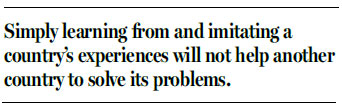
A country's cultural traditions may be unique but they are partly congruous with others. So, in Lee's view, it would be misleading to use one country's advantages to measure another's disadvantages. Given the inherent differences between any two countries, it is not possible for two countries to be completely alike. Simply learning from and imitating a country's experiences will not help another country to solve its problems.
By having an in-depth understanding of histories, cultures, political systems and governance philosophies, a country can explore a development road suitable to its own national conditions. The strong leadership, highly efficient government and the rule of law Lee advocated as the three conditions for social progress, however, could be used as references by countries, including China.
The author is an associate professor in the School of International Relations and Diplomacy, Beijing Foreign Studies University.



I’ve lived in China for quite a considerable time including my graduate school years, travelled and worked in a few cities and still choose my destination taking into consideration the density of smog or PM2.5 particulate matter in the region.
Copyright 1995 - . All rights reserved. The content (including but not limited to text, photo, multimedia information, etc) published in this site belongs to China Daily Information Co (CDIC). Without written authorization from CDIC, such content shall not be republished or used in any form. Note: Browsers with 1024*768 or higher resolution are suggested for this site.
License for publishing multimedia online 0108263 Registration Number: 130349