 |
|
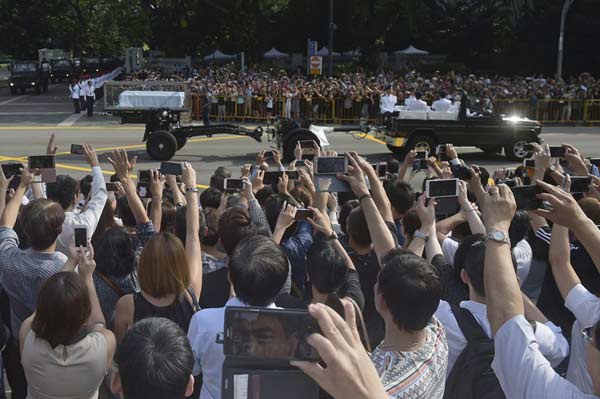
Members of the public take pictures and shout "Thank you, Mr Lee!" as the coffin of Singapore's founding father Lee Kuan Yew leaves Istana to lie in state at parliament, March 25, 2015. [Photo/IC] |
Lee Kuan Yew, Singapore's founding father who died on March 23, has been widely praised for his governance and insightful comments on global situations. His persistent efforts for efficient governance have been lauded by leaders in Asia, although some Western observers have criticized him for being autocratic.
For China, the Lee-spearheaded development of Singapore has been an example of an Asian country realizing good governance and economic growth. Many governments have tried to replicate Singapore's democratic politics and social model. But despite its huge success, Singapore's experiences cannot be imitated by China because of the differences between the two countries.
Lee's governance model and the underlying political mindset can be traced to his views on the essence of politics and the tactics to realize political goals. The chaotic era in which Lee was born and the recession the then British colony suffered shortly after World War II caused Lee to realize the "evils" of politics.
Colonial rule and the plundering of weaker countries by the big powers made Lee better understand international relations. These personal experiences forged his perception that there is nothing romantic about the politics represented by governments and that power is not necessarily equivalent to virtues. Lee believed that the "evils" of government must be restricted by the system and rule of law. And he transferred this into law, as is evident from stern legal system in Singapore.
Under the influence of Confucianism, Lee believed a society's basic values are order, stability and harmony. Diligence and enterprise, he said, were the top qualities needed to promote a country's progress. What he wanted to see is a bustling and prosperous society. No wonder, the creation of wealth and technological innovation became the dominating values in Singapore under Lee.
In terms of governance tactics, Lee proceeded from reality, tried to strike a balance among different values and refrained from going to extremes. But when it came to fighting corruption and promoting the rule of law, Lee did not hesitate to take extreme measures.
Lee's governance philosophy was not subject to a specific theory - it was neither purely Eastern nor Western. He believed in allowing the guiding principles to solve problems to determine political governance and social development. He also believed that a good government is one with the rule of law and tolerance.



I’ve lived in China for quite a considerable time including my graduate school years, travelled and worked in a few cities and still choose my destination taking into consideration the density of smog or PM2.5 particulate matter in the region.
Copyright 1995 - . All rights reserved. The content (including but not limited to text, photo, multimedia information, etc) published in this site belongs to China Daily Information Co (CDIC). Without written authorization from CDIC, such content shall not be republished or used in any form. Note: Browsers with 1024*768 or higher resolution are suggested for this site.
License for publishing multimedia online 0108263 Registration Number: 130349