 |
|
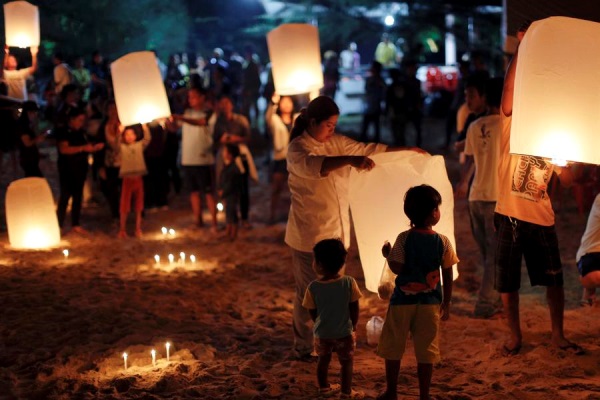
Survivors of Asia's 2004 tsunami and relatives of its 226,000 victims cried and prayed as they gathered along Indian Ocean shorelines on Dec.26, 2014 for memorials to mark the 10th anniversary of a disaster that still leaves an indelible mark on the region. REUTERS/Athit Perawongmetha |
This joint Op-Ed is submitted for publication by Dr Shamshad Akhtar and written by
Ministers from India, Indonesia, the Maldives, Sri Lanka and Thailand.On 26 December 2004, the world experienced one of the deadliest natural disasters ever recorded. A 9.1 magnitude earthquake off the west coast of Sumatra, Indonesia, triggered a massive tsunami that directly affected fourteen countries in Asia and Africa. The tectonic shifting of plates and the widespread impact of the resulting waves, led to 230,000 deaths and massive human suffering.
Ten years later, we come together as a community to commemorate the loss of those who fell victims to the wrath of nature and to recognize the suffering due to the natural disasters that have hit our region. This month, several affected countries in the region will host remembrance ceremonies for the Indian Ocean Tsunami. This is an opportunity to raise public awareness in the Asia-Pacific region and beyond on the importance of building greater resilience to natural disasters, and how we can collectively work to maintain this momentum enhancing our capacities to deal with such catastrophic events.
The 2004 Tsunami led to an unprecedented global outpouring of support, and a key lesson from the human tragedy was the importance of early warning. When the wave struck, early warning systems were inadequate. As a result, many received no warning except the sight of the wall of water rushing towards them. Our region must never again be caught so unprepared.
In the aftermath, the Asia-Pacific region embarked on a collective effort to develop approaches and mechanisms for better early warning systems to reduce the impact of future disasters. These efforts have intensified over the intervening years in Asia and the Pacific, the most disaster-prone region in the world. Building resilience in this region is not an option but an imperative to safeguard and promote sustainable development, lives and livelihoods.
The Indian Ocean Tsunami fundamentally changed how we deal with natural disasters, making a profound impact on policies and budgets as well as operational and technical work. Importantly, the experience of the Tsunami shaped the Hyogo Framework for Action (HFA), which was adopted in Kobe, Japan, weeks after the disaster.
Real progress has been made in implementing the HFA and building Asia-Pacific resilience. Governance has been strengthened, with more than half of Asia-Pacific countries having enacted legislation and created institutions dealing specifically with disaster risk management. The budgetary allocations for disaster risk and mitigation works have been improved - although this varies across countries. Institutional capacities for early warning, preparedness and response have also been strengthened, but more must be done. The countries of Asia and the Pacific are redoubling efforts to reinforce implementation capacities, educate vulnerable communities and address underlying risks.
The regional commitment to early warning is reflected in the Indian Ocean Tsunami Warning and Mitigation Systems (IOTWS), which became operational in 2011, with Australia, Indonesia and India in charge of issuing regional tsunami bulletins. The United Nations Economic and Social Commission for Asia and the Pacific (ESCAP) projects that this new system will save an average of 1,000 lives each year for the next 100 years.


Copyright 1995 - . All rights reserved. The content (including but not limited to text, photo, multimedia information, etc) published in this site belongs to China Daily Information Co (CDIC). Without written authorization from CDIC, such content shall not be republished or used in any form. Note: Browsers with 1024*768 or higher resolution are suggested for this site.
License for publishing multimedia online 0108263 Registration Number: 130349