|
 |
|
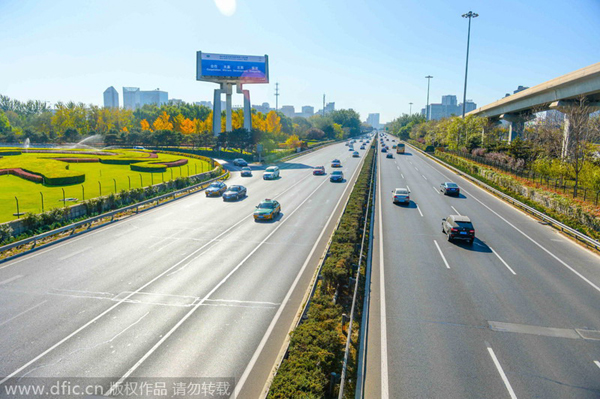
Cars travel on an uncrowded highway that is usually jammed with traffic ahead of the Asia-Pacific Economic Cooperation (APEC) Economic Leaders' Meeting in Beijing, China, 3 Nov 2014. |
With Beijing planning to make the license number rule permanent, we debate what is more important: an individual’s right to drive, or the collective benefit of the society?
Road space rationing is not the answer
As a temporary measure, the odd-even license number driving rule drastically reduced air pollution and traffic jams during the Beijing 2008 Olympics and last month’s Asia-Pacific Economic Conference conference.
But the measure cannot be made a permanent fixture. A car is legal private property of a citizen, and if the government bans him/her from using it on certain days of the week it will infringe upon one of his/her fundamental rights.
Moreover, the Fourth Plenum of the 18th Central Committee of the Communist Party of China emphasized the rule of law, and no law entitles the government to permanently force half of the vehicles off the road. Article 39 of the Road Traffic Safety Law should be applied to only temprorary situations. And the government can take such measures only after the Beijing local legislature passes a local law to that effect. Such measures should not be implemented without soliciting public opinions, otherwise they could face opposition.
Besides, the odd-even license number rule (or road space rationing) reminds one of the planned economy years when administrative orders were used to intervene in the economy.
The central leadership has been emphasizing that the market should play the decisive role in the economy. So how could Beijing’s local authorities impose such a rule?
The Beijing transport authorities should learn from the experiences of municipalities in other countries, which use economic measures such as charging congestion fees, raising parking fees and/or auctioning car licenses, to limit the number of cars on the roads. In London, the authorities have been charging congestion fee in the central part of the city on weekdays since 2003, which has effectively eased traffic pressure and cut emissions.
The Shanghai municipal government, too, has reduced the sales of cars by holding auctions for license plate numbers. By September 2010, Shanghai had only 1.67 million cars, or about one-third the number in Beijing despite having a comparable population.
Many people oppose such fees and auctions because they increase the cost of owning a car. In a society where smooth traffic and clean air are a luxury, driving should be considered a luxury, too. But for that, the government has to improve the public transport system. And the money needed for this purpose can some from the congestion fees and auctions for license plates to ensure people enjoy comfortable commuting.
The author is a professor at School of Public Administration and Policy, Renmin University of China.
 Considering money as the end is the tragedy

Copyright 1995 - . All rights reserved. The content (including but not limited to text, photo, multimedia information, etc) published in this site belongs to China Daily Information Co (CDIC). Without written authorization from CDIC, such content shall not be republished or used in any form. Note: Browsers with 1024*768 or higher resolution are suggested for this site.
License for publishing multimedia online 0108263 Registration Number: 130349