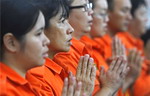
The primary political and educational objective of confronting young Germans with their country's darkest past and their forefathers' guilts, above all, is to make them aware of the magnitude and consequences of Hitler's atrocities and war crimes so that history never repeats itself.
The Japanese have yet to face their past, a past when their forefathers wantonly massacred hundreds of thousands of innocent people, committed untold atrocities in China (and other parts of Asia) and forced women into sex slavery.
Then there is the repeated ritual of Japanese prime ministers visiting the Yasukuni Shrine, which honors 14 Class-A war criminals convicted in the Tokyo Trials and has been a source of tension alienating Japan from its neighbors, principally China, the Republic of Korea and the Democratic People's Republic of Korea. The visits to the shrine are a reminder that Japan's supra-nationalism, which underpinned its aggression in the past, is far from dead. Prominent among the 14 convicted war criminals honored at Yasukuni is Hideki Tojo, the general who upon becoming prime minister in October 1941 approved war plans against the British, Dutch, French and American territories. He also ordered the attack on Pearl Harbor.
Thus, Japanese Prime Minister Shinzo Abe's visit to Yasukuni on Dec 26, 2013, has touched off a storm of fury in China and the ROK.
To optimists, there seems to be a ray of hope because the visits to the shrine do not seem to command unanimous domestic support. For example, on July 20, 2006, the Nihon Keizai Shimbun (Japanese Economic News) published the private notes of the late Tomohiko Tomita, former head of the Imperial Household Agency (Kunaicho), revealing for the first time that the late Emperor Showa (Hirohito 1926-89) strongly objected to the enshrinement of 14 Class-A war criminals among the war dead in Yasukuni in 1978. Tomita's notes say that the emperor, who had visited Yasukuni eight times before, stopped doing so from 1978 onward.
Also, a public opinion poll, in July 2006 by Nihon Keizai Shimbun, asked respondents whether they supported prime ministers visiting Yasukuni. About 53 percent of them said they were opposed to such visits, with only 28 percent supporting them.
The harsh reality is that in Japan's postwar parliamentary system, the prime minister (with his cabinet) rules the country under the nominal aegis of the emperor, and 53 percent of the people do not carry enough weight to crack the prime minister's control over the political agenda because of the country's weak civil society.
The obstacle to Japan's atonement continues to reside in its official oblivion to its ugly past and the massive loss of memory of the Japanese nation, because the postwar generations are not taught the truth about its war guilt. Will the 14 Class-A convicted war criminals continue to be worshipped as Japanese war heroes, something inconceivable in Germany?
The author is a professor of politics and international law at New York University and has the book, China and Japan at Odds: Deciphering the Perpetual Conflict, to his credit.
 New type of urbanization is in the details

Copyright 1995 - . All rights reserved. The content (including but not limited to text, photo, multimedia information, etc) published in this site belongs to China Daily Information Co (CDIC). Without written authorization from CDIC, such content shall not be republished or used in any form. Note: Browsers with 1024*768 or higher resolution are suggested for this site.
License for publishing multimedia online 0108263 Registration Number: 130349