Japan tries to justify Abe's shrine visit
|
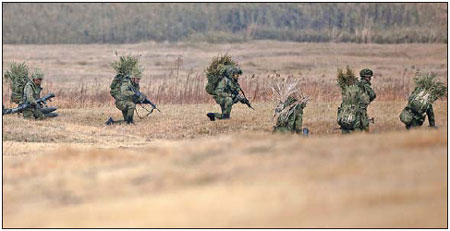
Members of Japan's Ground Self-Defense Force 1st Airborne Brigade take part in an annual New Year's military exercise at Narashino exercise field in Funabashi, east of Tokyo, on Sunday. Issei Kato / Reuters |
Japan has sent senior diplomats on far-flung missions worldwide to justify the troublemaking pilgrimage by Prime Minister Shinzo Abe to the controversial Yasukuni Shrine, which honors convicted war criminals.
Meanwhile, more than a dozen Chinese ambassadors around the globe published articles in leading newspapers recently to criticize the hypocrisy behind the hawkish Japanese leader's "no war" pledges.
Ichita Yamamoto, Japan's minister in charge of Ocean Policy and Territorial Issues, started his six-day tour to Southeast Asia on Sunday to justify Abe's Dec 26 pilgrimage to the shrine, local media said.
Japanese Vice-Foreign Minister Nobuo Kishi, the younger brother of Abe, will visit the United States from Monday to Friday, and Japanese newspaper Sankei Shimbun said his itinerary will include "explanations about the actual considerations" behind Abe's homage.
Abe's visit not only worsened Japan's diplomatic deadlocks with China and South Korea but also prompted a rare publicly statement of disappointment from the United States.
The Abe Cabinet is now busy with damage control because "few voices outside Japan defended Abe's right-wing style pilgrimage", and there has been a consensus worldwide that such an offensive homage poses an impending threat to the peace and stability of the Asia-Pacific region, said Yang Bojiang, deputy director of the Institute of Japan Studies at the Chinese Academy of Social Sciences.
Both the Japanese defense minister and foreign minister served as firefighters, putting out the flames set by Abe, during their respective New Year's trips abroad last week.
"Abe had underestimated the magnitude of the strong reactions from around the world (before his shrine visit), and he had not foreseen such criticism," Yang said.
At least 13 Chinese ambassadors have had articles published blasting Abe's visit, spanning from Europe to Africa and North America.
Cui Tiankai, Chinese ambassador to the US, wrote in an opinion article published in the Washington Post on Thursday that the Yasukuni Shrine is "ground zero for the unrepentant view of Japan's wartime aggression".
"Abe is prime minister, his homage has implications inside and outside Japan. It is by no means the act of a private individual," wrote Cui, the Chinese ambassador to Japan from 2007 to 2009.
In a Friday article published by Russia's Interfax news agency, Chinese Ambassador to Russia Li Hui said Abe's move challenged generally accepted rules and norms and was "an open provocation against justice in international relations and insolent trampling of mankind's common sense".
Publishing articles in influential newspapers is an effective way to boost public diplomacy and deliver needed information to the people there, said Ruan Zongze, vice-president of the China Institute of International Studies.
"Those nations have unforgettable memories of World War II, and many of them were even the contracting parties of key postwar legal documents, such as the Declaration of Cairo," Ruan said.
Abe has ordered Japan's Ministry of Foreign Affairs to require embassies around the world to fight back and publicize his pledge of "no war" during the pilgrimage, Japan's Jiji news agency confirmed on Friday.
"Abe is seeking another confrontation between Japan and China in the international arena of public diplomacy," said Liu Jiangyong, deputy dean of the Institute of Modern International Relations at Tsinghua University.
Tensions on the East China Sea were once again stirred by Tokyo on Sunday. The parachute unit of the Japanese Ground Self-Defense Forces conducted a routine New Year's drill on Sunday and mobilized around 300 soldiers.
The theme of the drill focused on the scenario of retaking remote islands from China, Japan's Asahi Television reported.
Local media on Sunday also confirmed that the Japanese Education Ministry is discussing imposing Japan's claim over China's Diaoyu Islands into the Course of Study - teaching manuals for the nation's junior and senior high schools.
Contact the writers at caihong@chinadaily.com.cn and zhangyunbi@chinadaily.com.cn